Learning Environments

Studio Twenty Seven Architecture specializes in educational master planning and K-12 charter school design. Studio Twenty Seven Architecture has designed and built more than fifty public charter schools. We understand the space and budget constraints that accompany the majority of non-municipal schools and over the years have enjoyed a noticeable level of success illustrating our creativity in stretching budgets and maximizing opportunities. Each year 78% to 85% of our work includes repeat clients. We believe this demonstrates our exceptional performance in terms of cost control, quality of work, and compliance with fixed performance schedules.
Working almost exclusively with academic clients, our work has received more than sixty Design Awards for Excellence on both a local and national level from the American Institute of Architects. Given the non-profit status of the majority of our clients, our typical project has a tightly defined schedule and budget. We believe the design awards acknowledgement from our peers illustrate our ability to deliver creative design solutions while simultaneously providing disciplined project and schedule management.
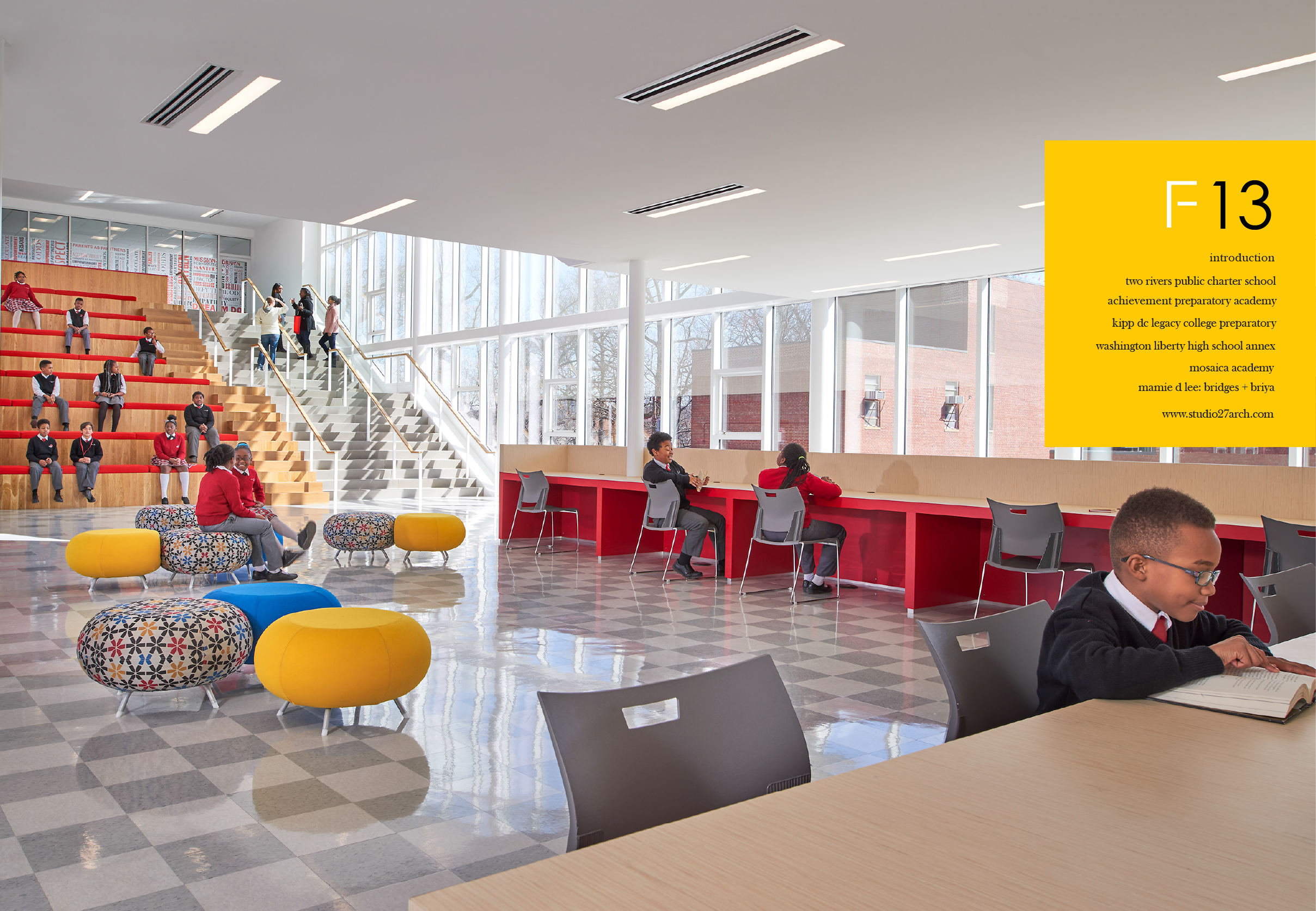
Fundamentally, we believe architecture to be a creative profession tasked with solving real world issues.
Studio Twenty Seven Architecture is a firm that believes architecture is a means of expressing thought through the language of space, light, tectonics, and phenomena. In our work we strive to use the language of architecture to express ideas and concepts that are relevant to our clients, their needs, and programs. We believe firmly in process as the means for achieving successful architecture and work closely with our clients and end users to ensure a design process that is disciplined in response to client and public comments. We also believe that buildings are not static structures but living creations that evolve over time and are required to cooperate within their context and ecosystem.
The term “sustainable design” emerged in the later quarter of the twentieth century to define a process that recognizes the finite nature of natural resources and the need to conserve their expenditure. But we believe “sustainable design” has always been a component of the artistic process. Some groups now quantify it as a means to connect with an economic model, but as an expression of logic and efficiency, we believe sustainable design has always been essential to purposeful architecture.
In this booklet we illustrate the breadth of creativity Studio Twenty Seven Architecture brings to our charter school designs.
being respectful to history
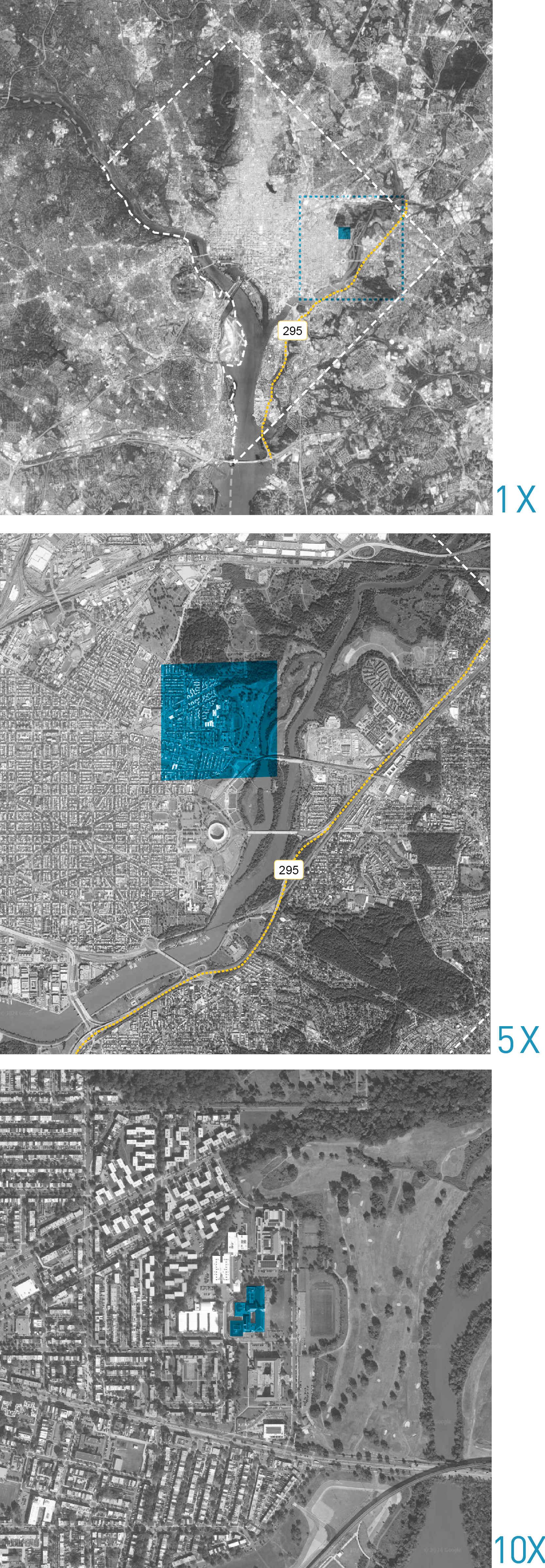
Washington Metropolitan Region
The “Hilltop Campus,” comprised of Young Elementary and three other D.C. public school buildings, operated as a carefully planned, segregated, public educational campus in the northeast quadrant of the District of Columbia from 1929 to 1954. Recognizing its historical significance, the entire campus earned a spot on the National Register of Historic Places in 2016. During its early years, this educational enclave witnessed the emergence of a close-knit African American community in the surrounding neighborhoods, notably Langston Carver and Kingman Park.
Northeast Washington, D.C.
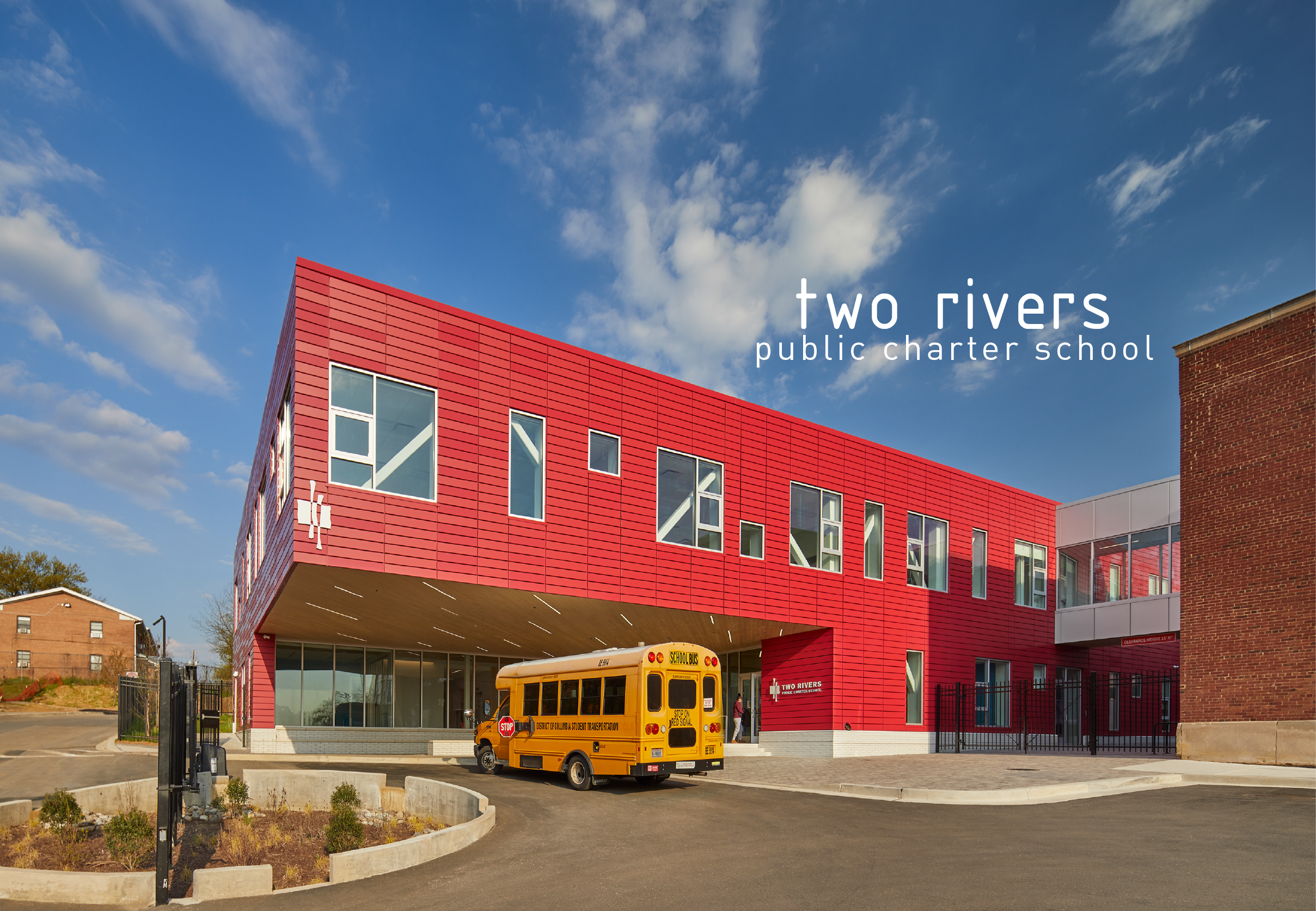
Today, this “Hilltop Campus” still serves as a collection of community-based schools, including Two Rivers Public Charter School at the Charles E. Young building. Two Rivers Public Charter School reopened the Young building after extensive renovations in 2015 as their new elementary school campus. In 2020, Two Rivers opened the latest addition to the campus, a two-story 28,000 square foot new addition designed for 300 middle school students.
Two Rivers Public Charter Middle School
This addition served a dual purpose: meeting the needs of a middle school program and establishing a distinct identity for the middle school apart from the elementary program. The project also involved the renovation of a portion of the existing Charles E. Young structure. Building on the site of the historic Young campus required a sensitivity to the existing building and approval by the State Historic Preservation Office.
Building a campus
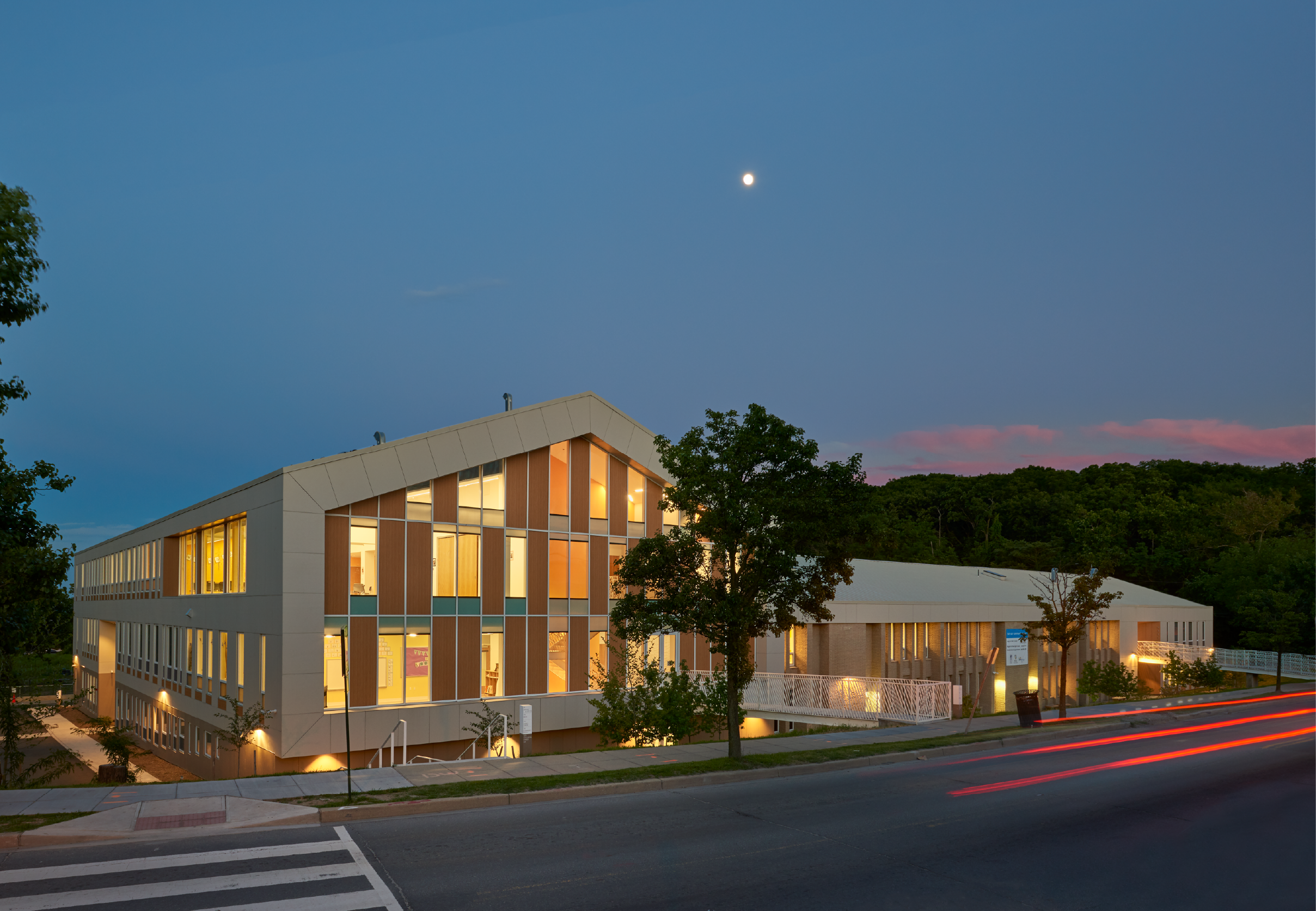
The Two Rivers Middle School project at Young Campus involved constructing a new two-story, 28,500 square foot free-standing building and renovating 14,400 square feet of shelled space within the existing building. Together, the renovated space and new building accommodate 300 middle school students. The building is connected to the existing Young building by a bridge at the second floor allowing a connection to the historic structure with minimal demolition and reconfiguration.
If the school is repurposed or serves a different-aged cohort of students, changes can be readily accommodated. The goal was to create a single educational campus but to also provide a sense of identity and separate community for the older middle school students, unique from the elementary program from which they have just graduated.
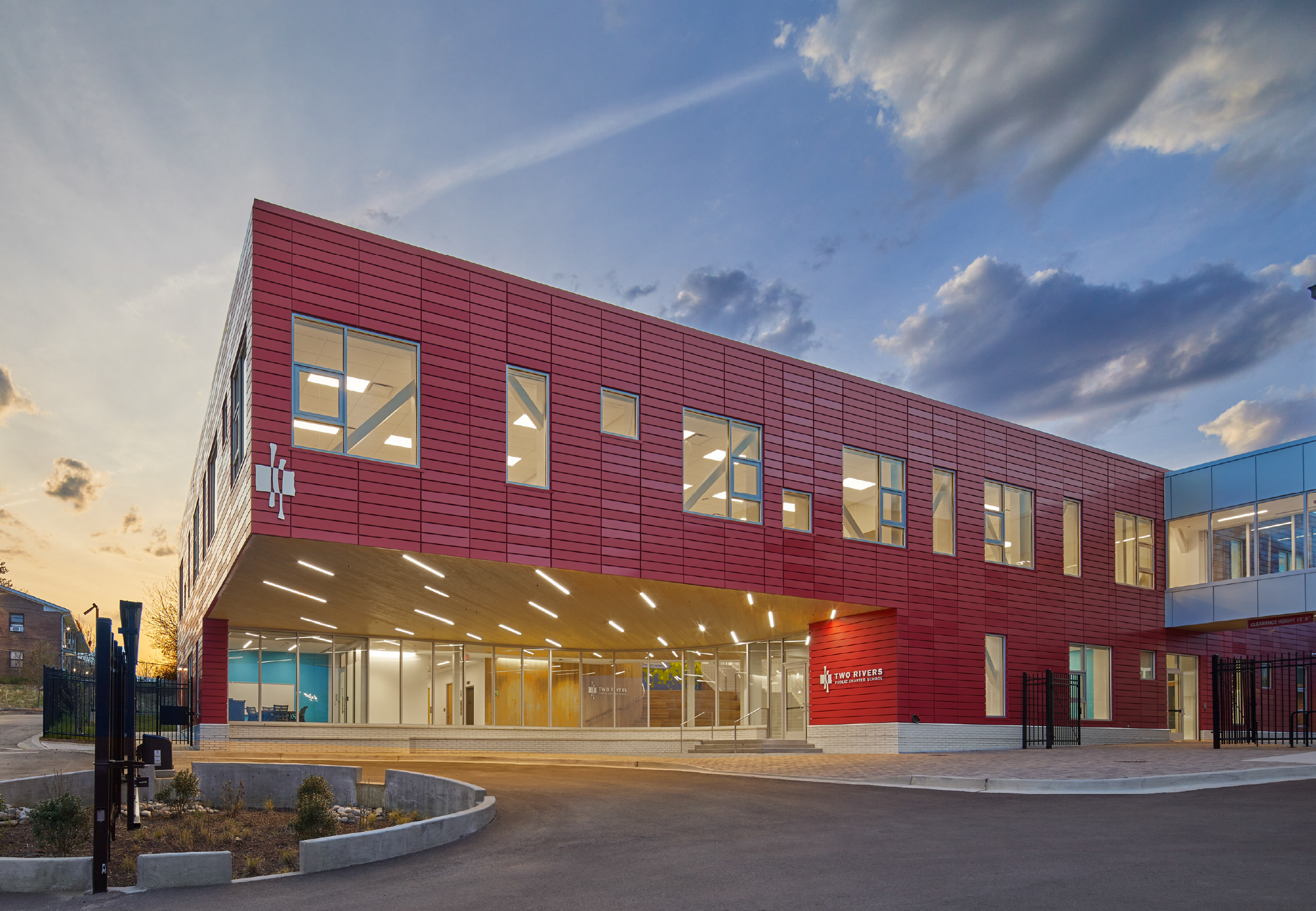
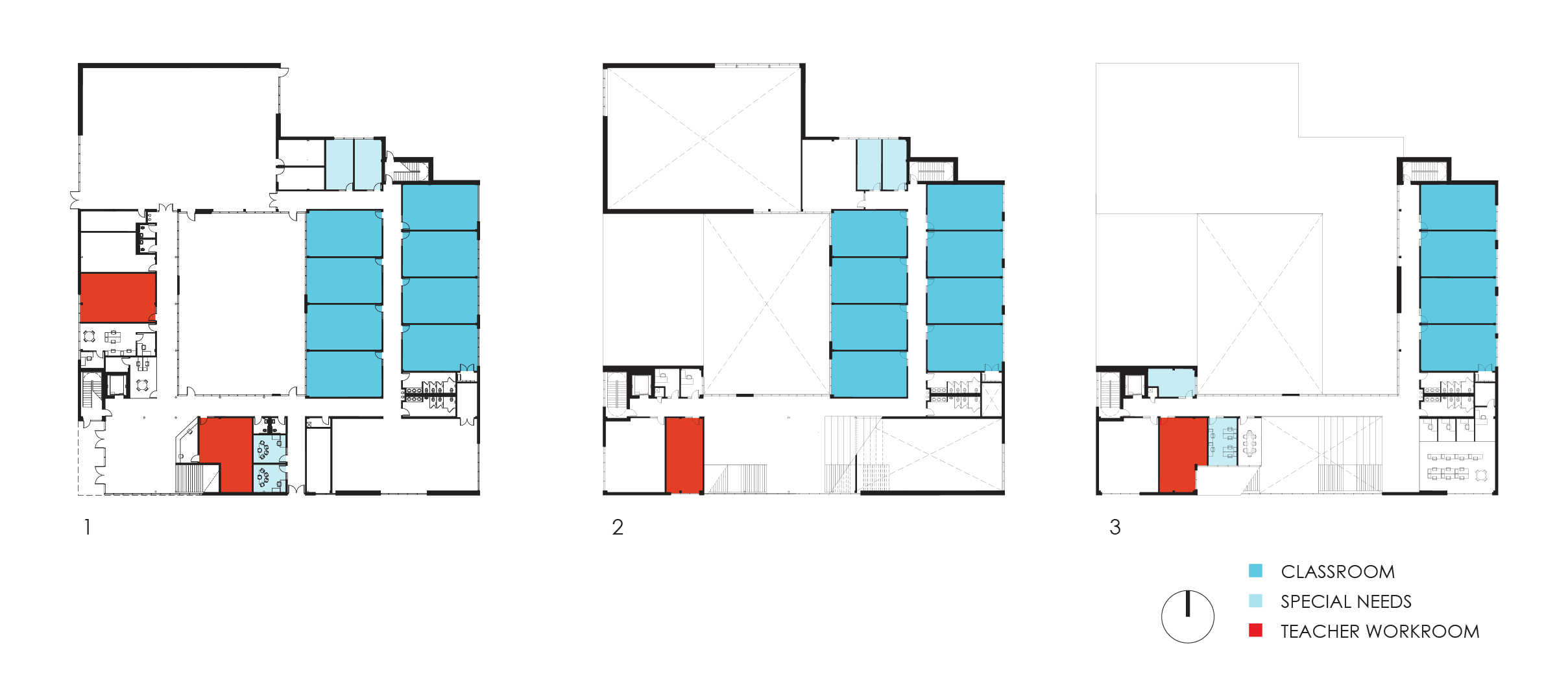
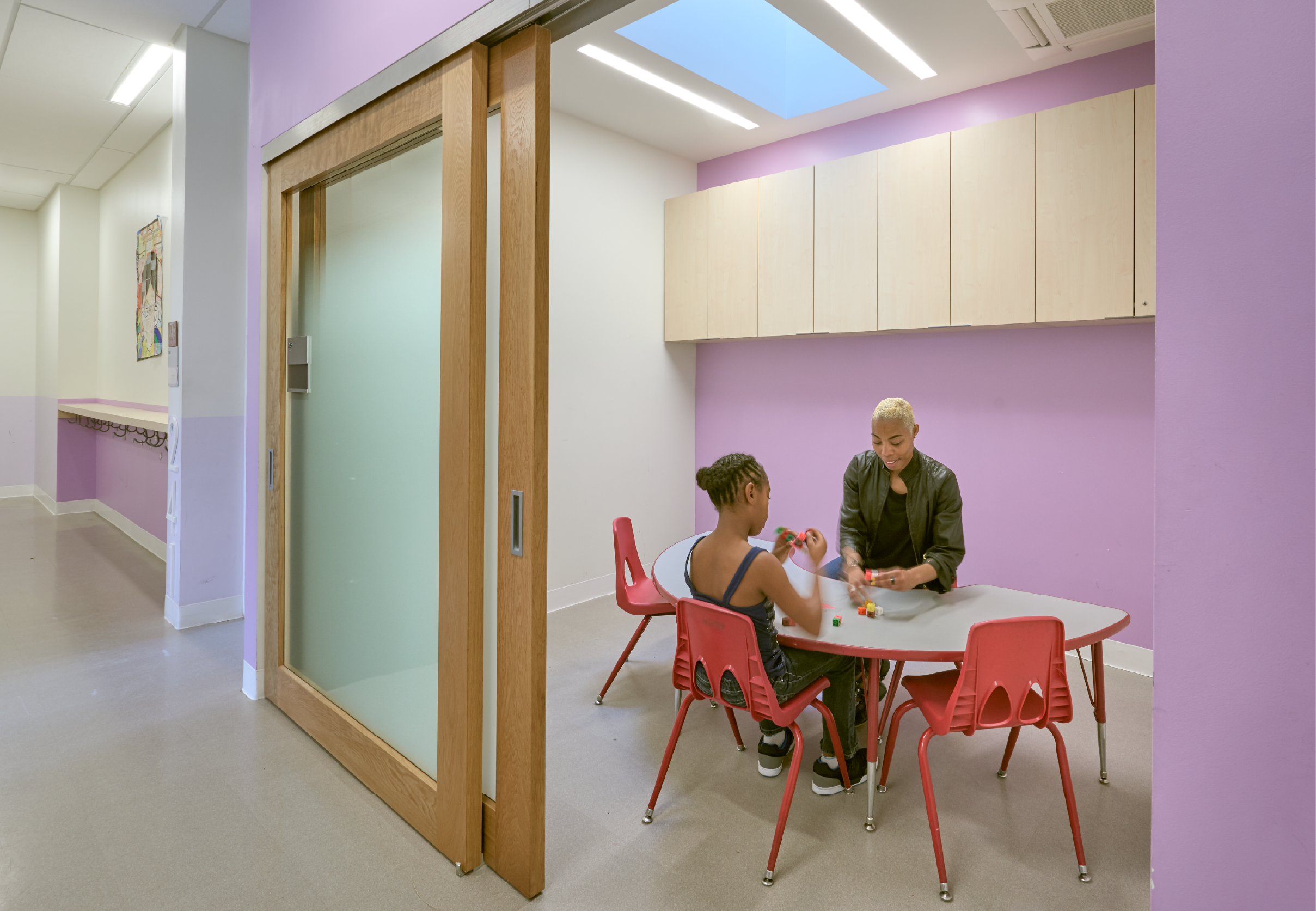
The new facility serves 6th through 8th graders, with core classrooms in the new building and additional spaces in the renovated area for art, drama, music, Spanish, and science classrooms. Administrative offices and teacher workrooms are evenly distributed between the two stories of the new building. Emphasizing Two Rivers’ focus on community, designated spaces are carved out for each grade level to promote expeditionary learning with flexible classroom environments.
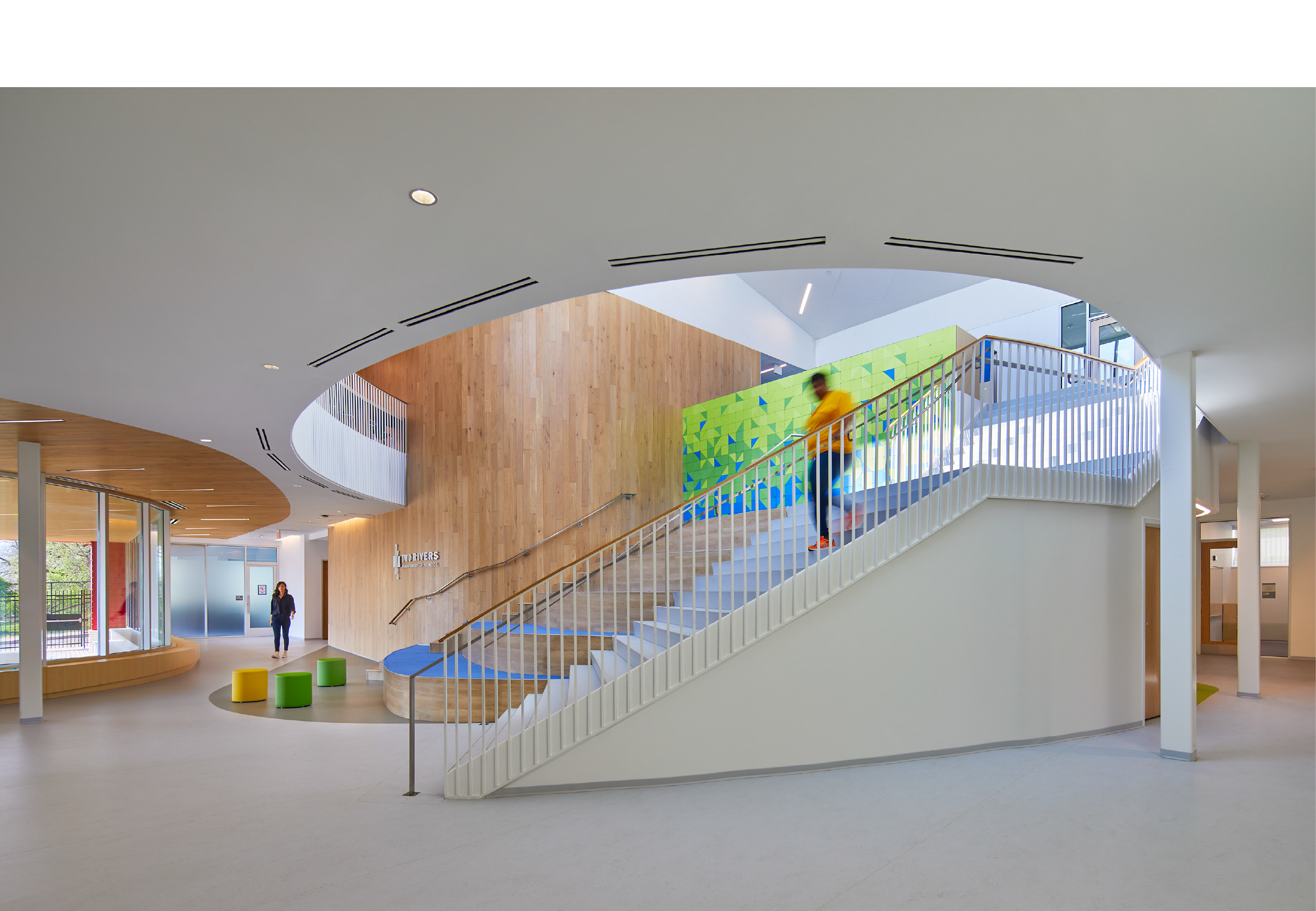
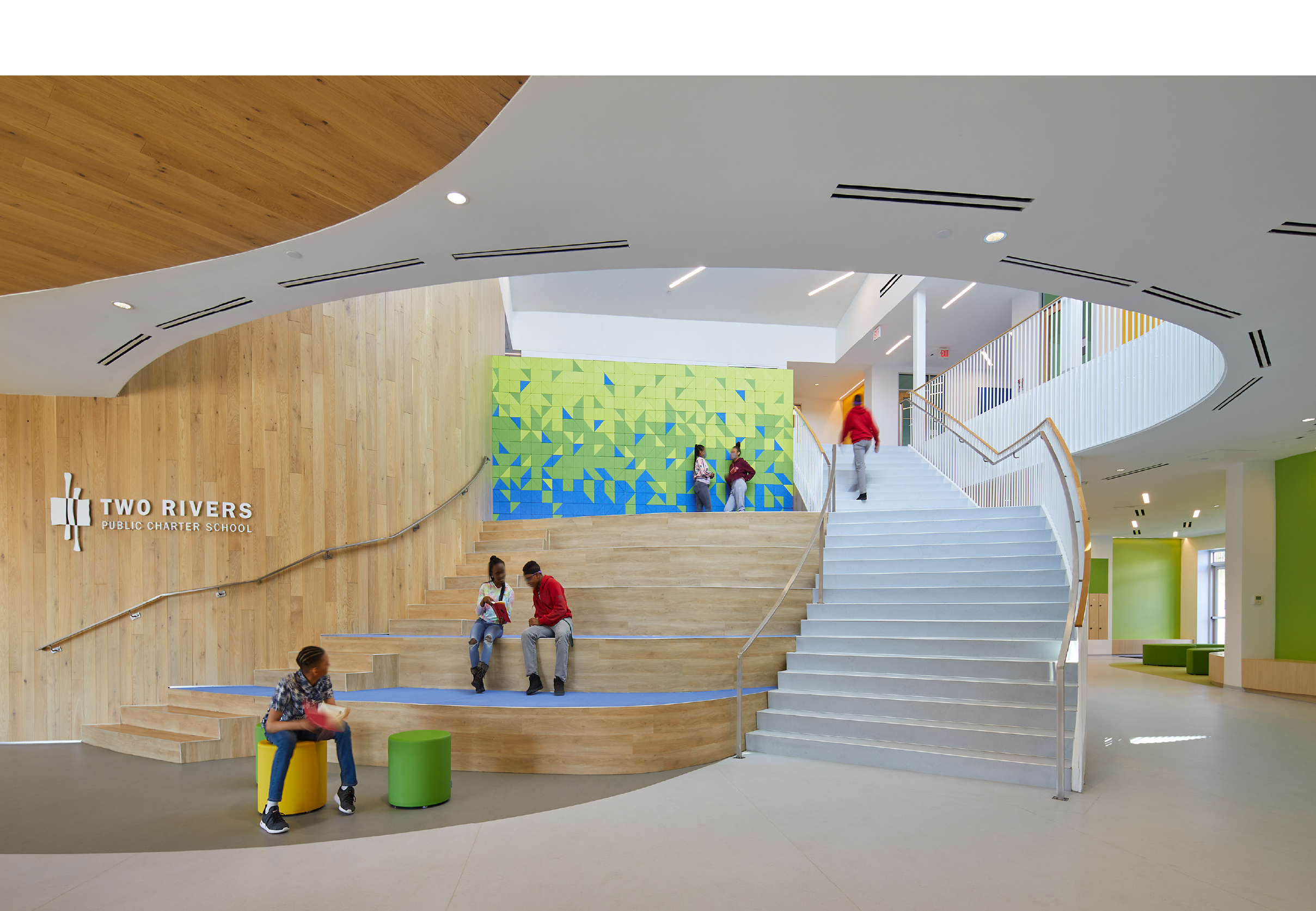
Two Rivers is a network of public charter schools fostering curiosity, character, and deep engagement with learning and with one another. The curriculum is centered on expeditionary-based learning and driven by a mission to nurture a diverse group of students to have a lifelong, active participation in their education. The ultimate goal is to help students develop a sense of self and community to become responsible and compassionate members of society.
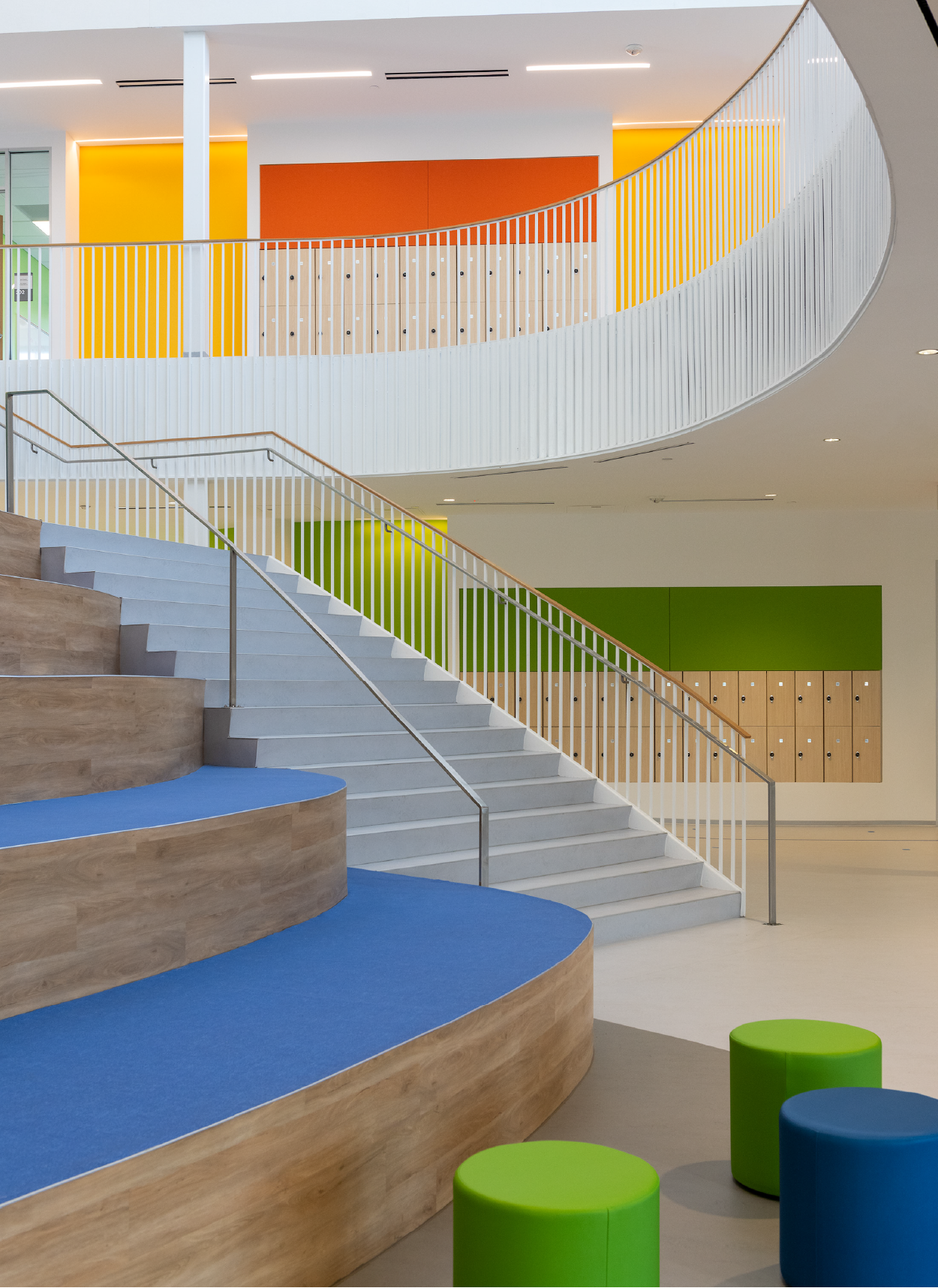
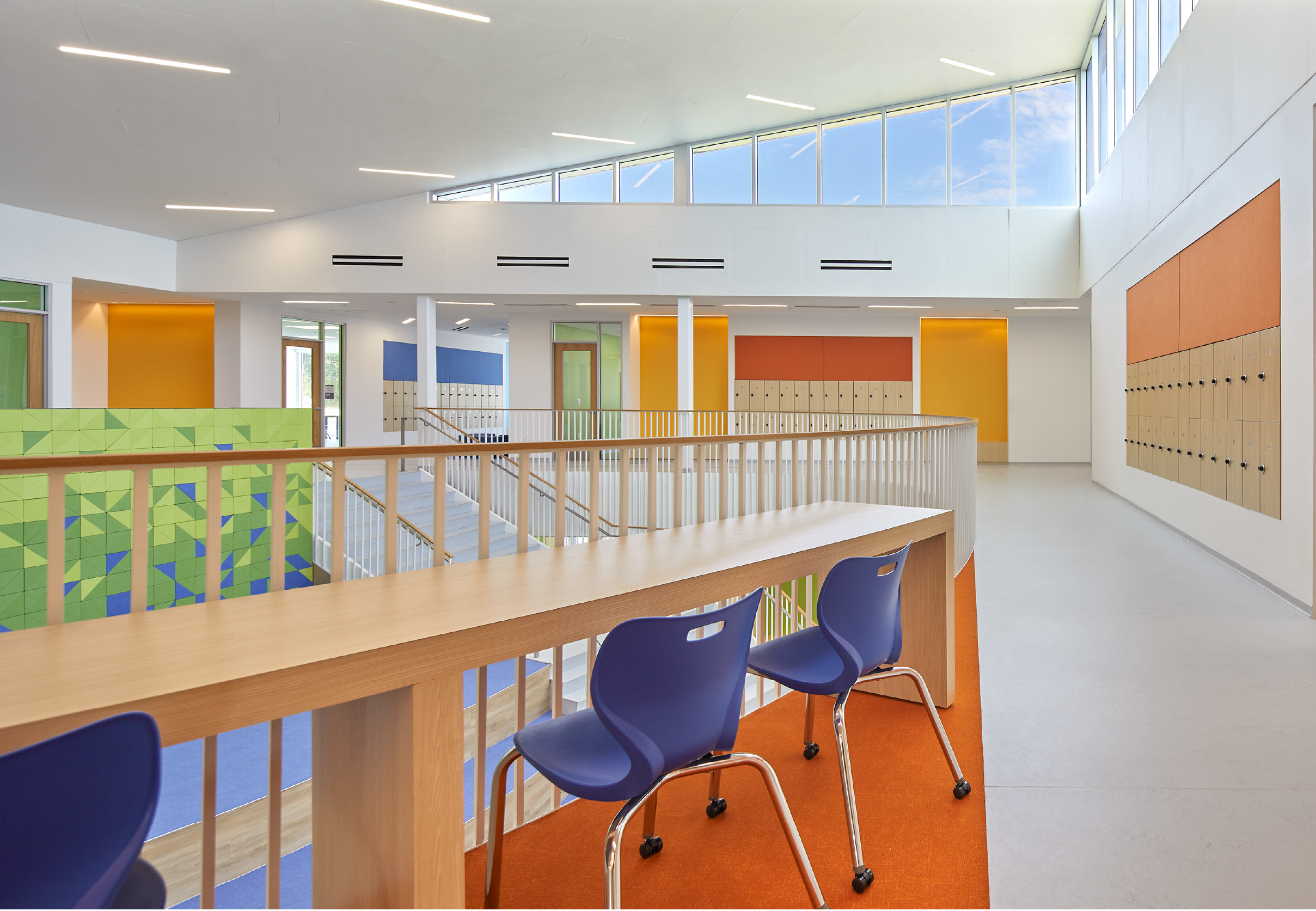
With community at the heart of Two Rivers mission, Studio 27 ensured that it was at the heart of the new middle school. The building is designed around a central community space and circulation stair awash in natural light from a daylight monitor above, illuminating the school at its core. The classroom spaces and corridors are organized around this volume of light. The building supports grades 6-8 and each grade level is given a unique color identity and community space. This creates a dynamic layering of community and color.
Closing the Achievement Gap
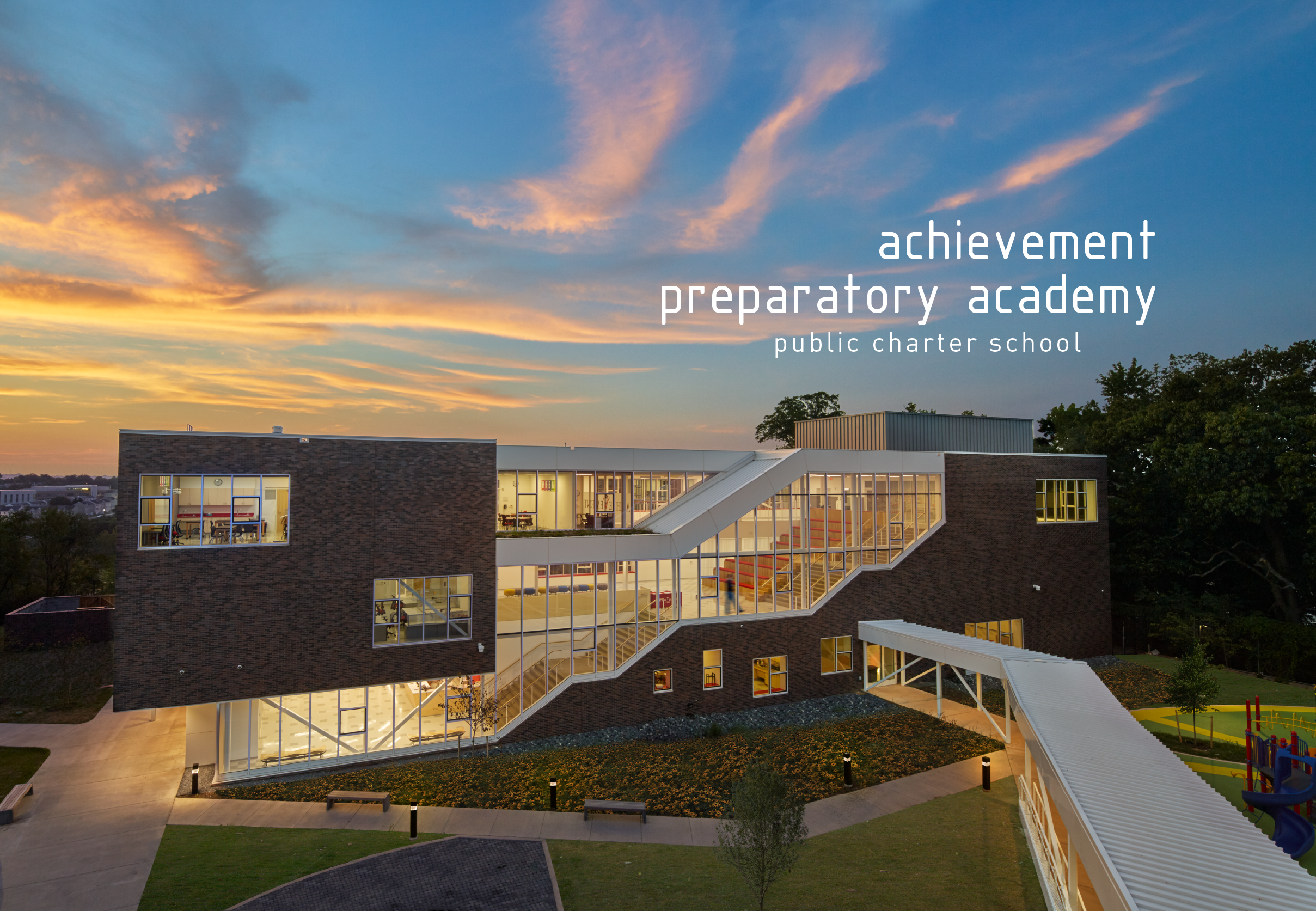
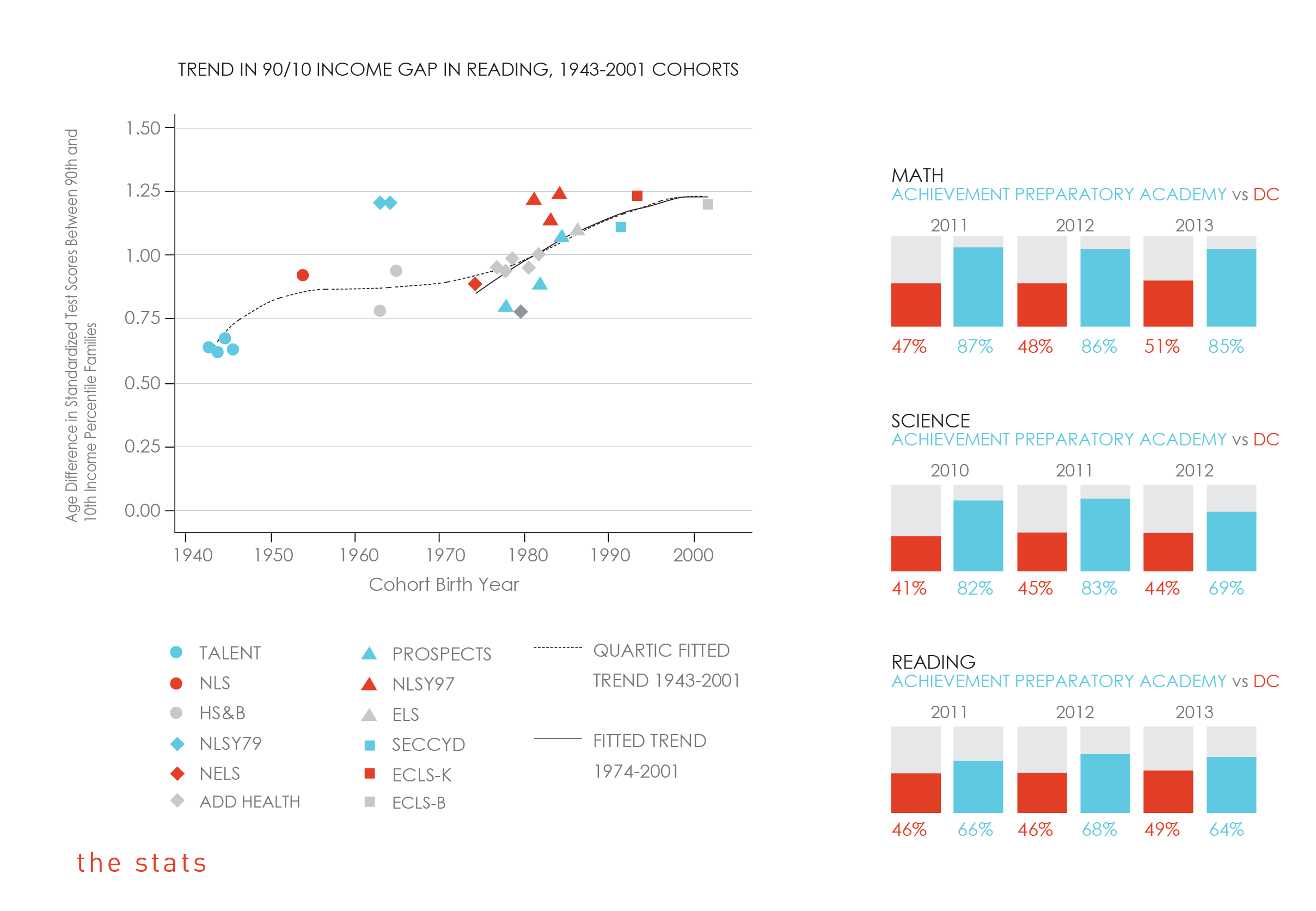
Achievement Preparatory Academy in Washington, D.C. was founded to close the achievement gap between wealthy white students and low-income students of color. Statistics concerning the “achievement gap” collected in 1999 remain relevant today: only 3 in 10 African American and 4 in 10 Latino 17-year-olds have mastered the usage and computation of fractions, commonly used percentages, and averages, compared to 7 in 10 white 17-year-olds.
Working with only half of the facility allowance provided to traditional public schools, charter schools in the District of Columbia require innovative and extremely cost-conscious design to foster their educational programs.
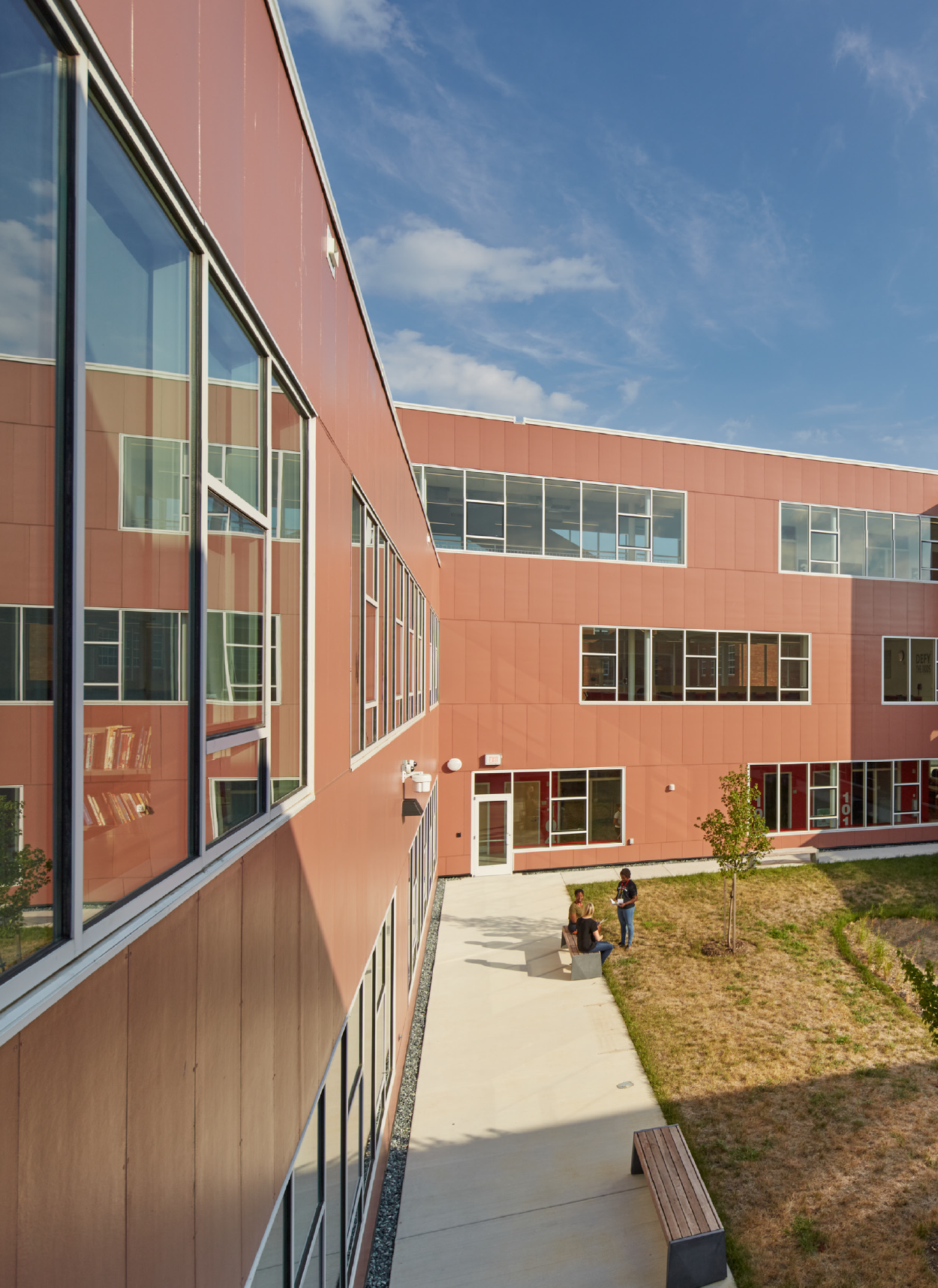
When Studio Twenty Seven Architecture began working with Achievement Prep, they had acquired a long-term lease of a D.C. public school’s property. The Draper School Building was built in the 1930s and was in need of a full renovation. The building still featured the original single pane windows, the majority of which would not fully close. Window units decorated the façade in an attempt to make the interiors bearable during the District of Columbia’s hot and humid summers. The interiors were a hodge-podge of inexpensive renovations. Despite the lacking facilities, APA had managed to become a high-performing charter school with some of the top performing scholars in the district.
Since 2008, Achievement Prep Academy has operated a middle school in the unrenovated Draper School Building. The founder, Shantelle Wright, had started APA as a middle school. She noticed the lack of good education options at the critical ages between elementary and high school. As APA grew, elementary and early childhood programs were added and operated in leased buildings in other locations around Ward 8.
The goal of the project would be to consolidate all of its programs onto a single campus so it can continue to serve the neighborhood surrounding Wahler Place SE. Studio Twenty Seven Architecture aimed to transform their facilities into a new campus that matched the caliber of the education being provided.
Mission + Site Driven
There are two elements that uniquely shape every one of Studio 27’s education buildings: the mission of the school and the site of the building. When those two elements begin to speak to one another, you create an education rooted in place.
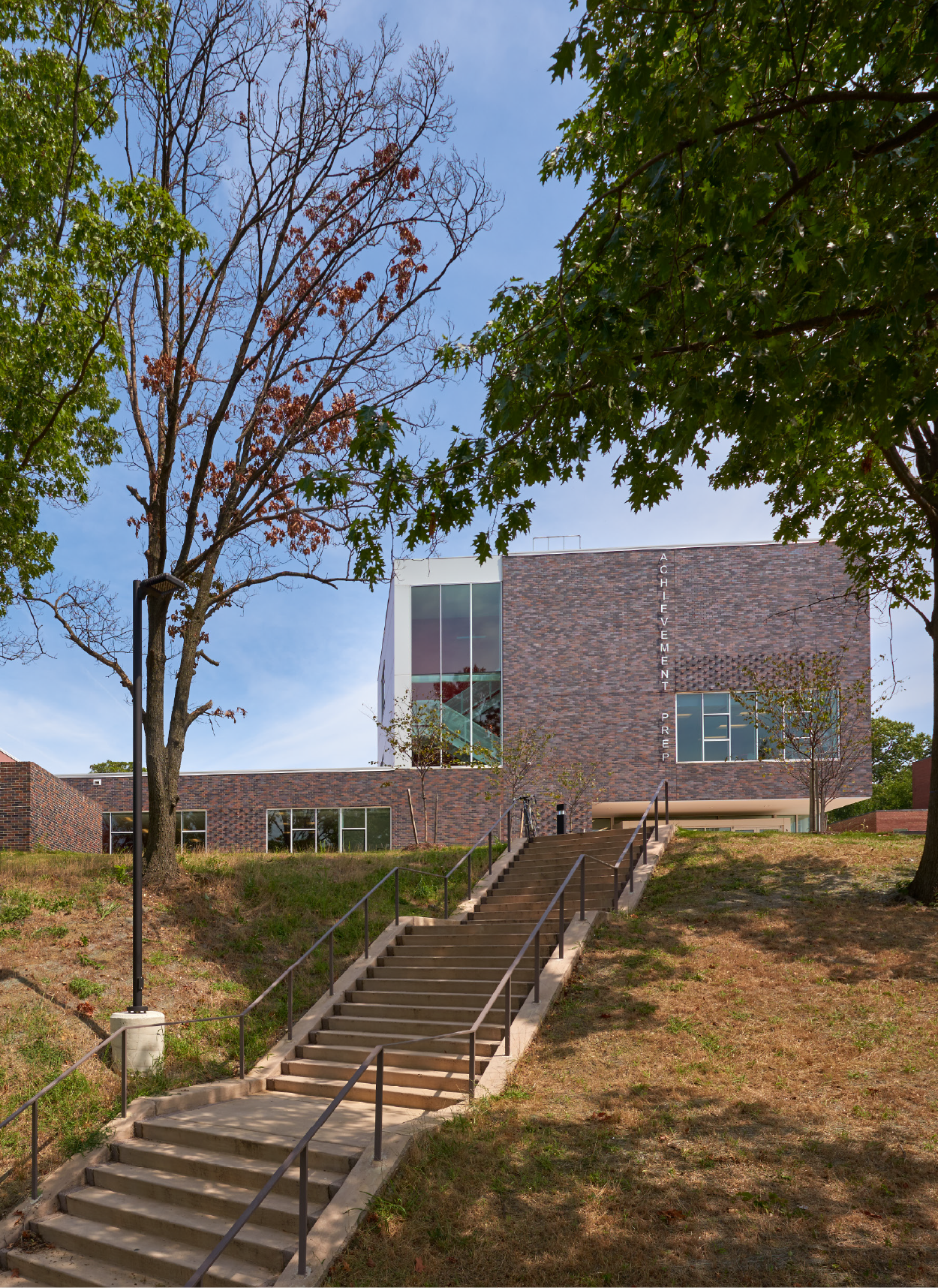
The site of Achievement Prep was at the high point of the neighborhood on a leveled hilltop on a corner lot. The existing Draper School Building sat close to the street with a large field behind for recreation. The sloped sides of the site created siting challenges for access to the backside of the campus, but Studio 27 quickly realized there was an opportunity in this plateau on a hill.
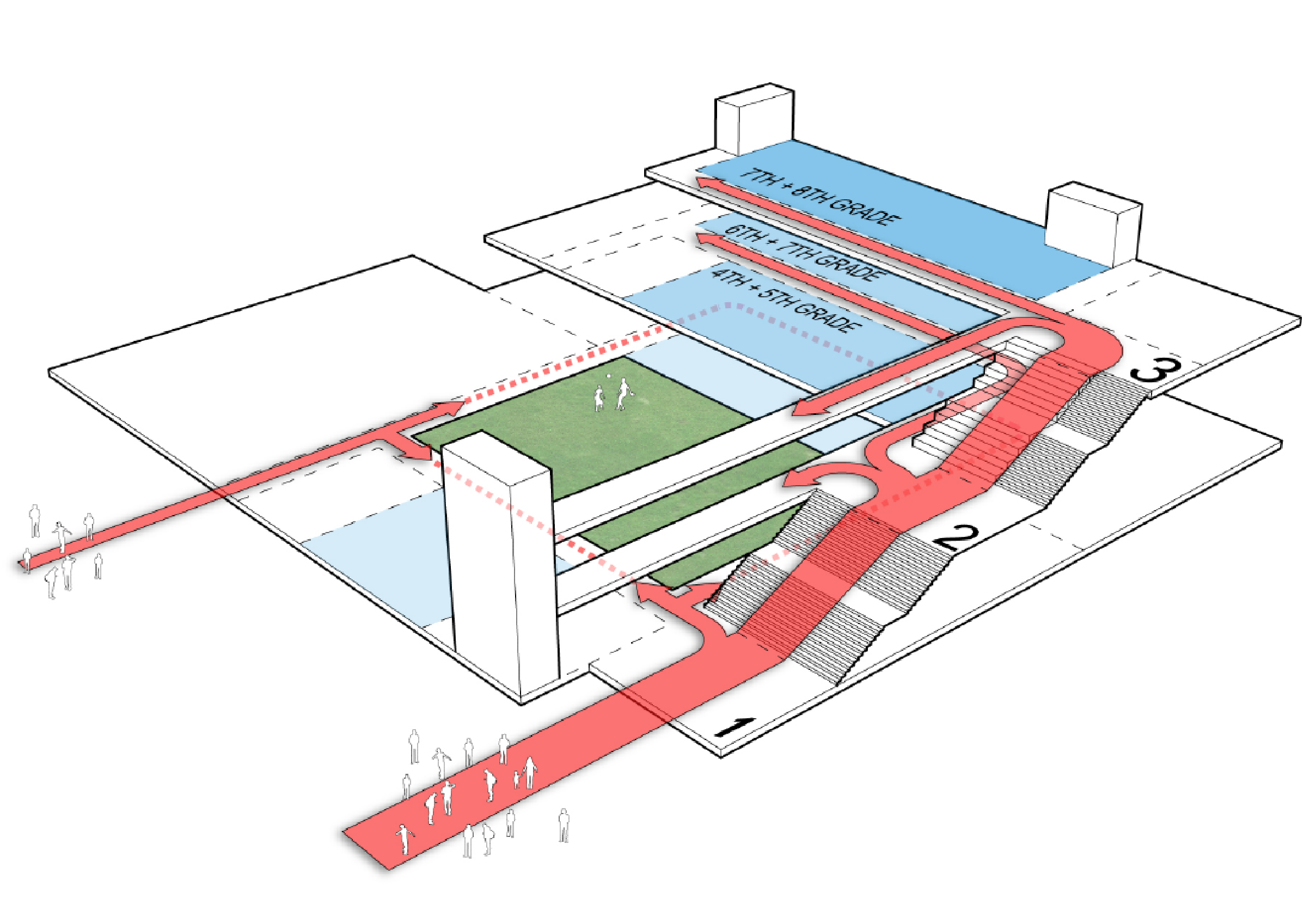
Arrival and dismissal are always a driver in the development of a school site. Studio 27 took great care to organize and separate arrival and dismissal of the two school groups: middle school and elementary school. It became clear that a site stair would be necessary to give the middle school students direct access to the new addition of the building. But what if that site stair, and the idea of ascent, became the backbone of the middle school?
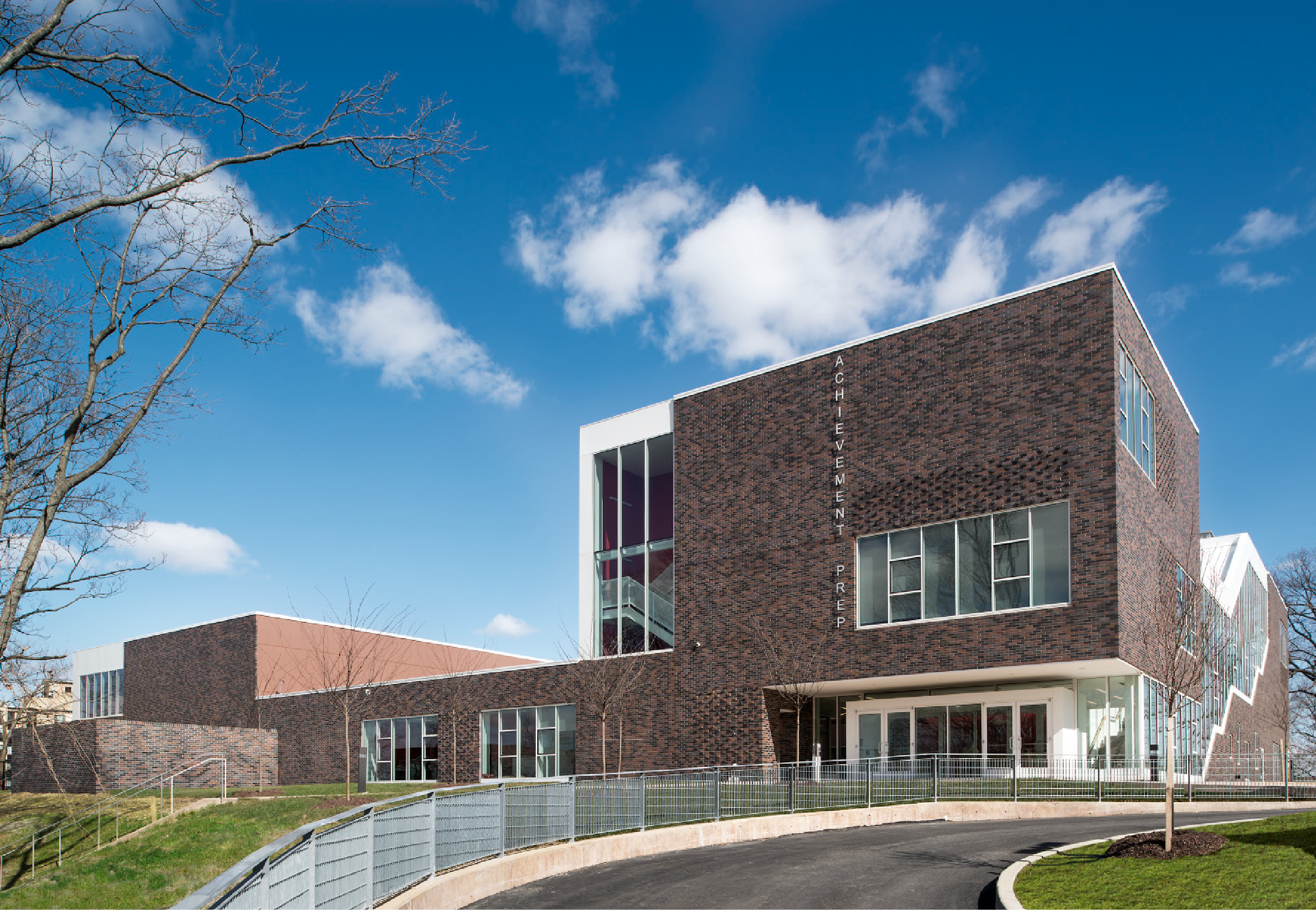
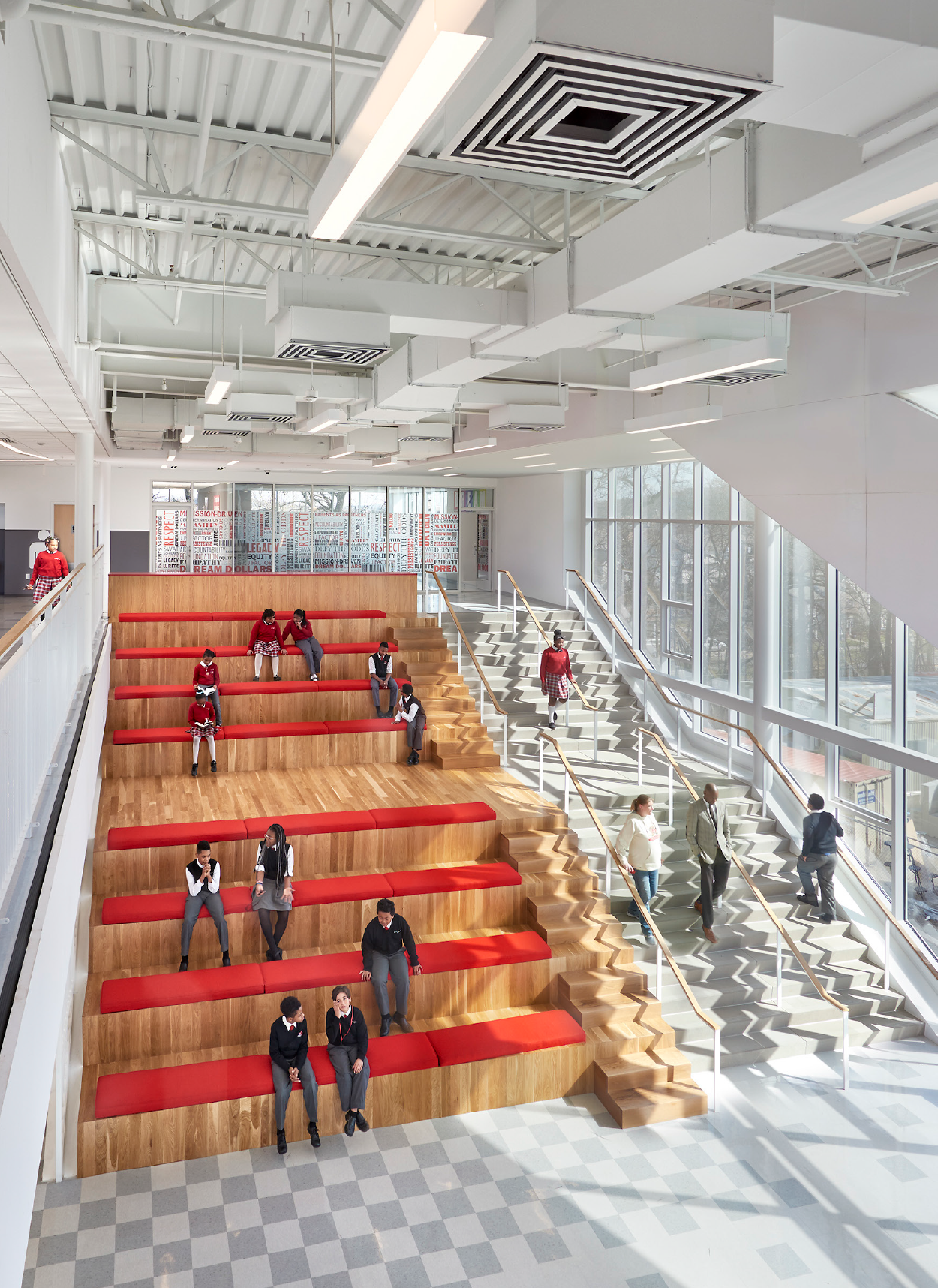
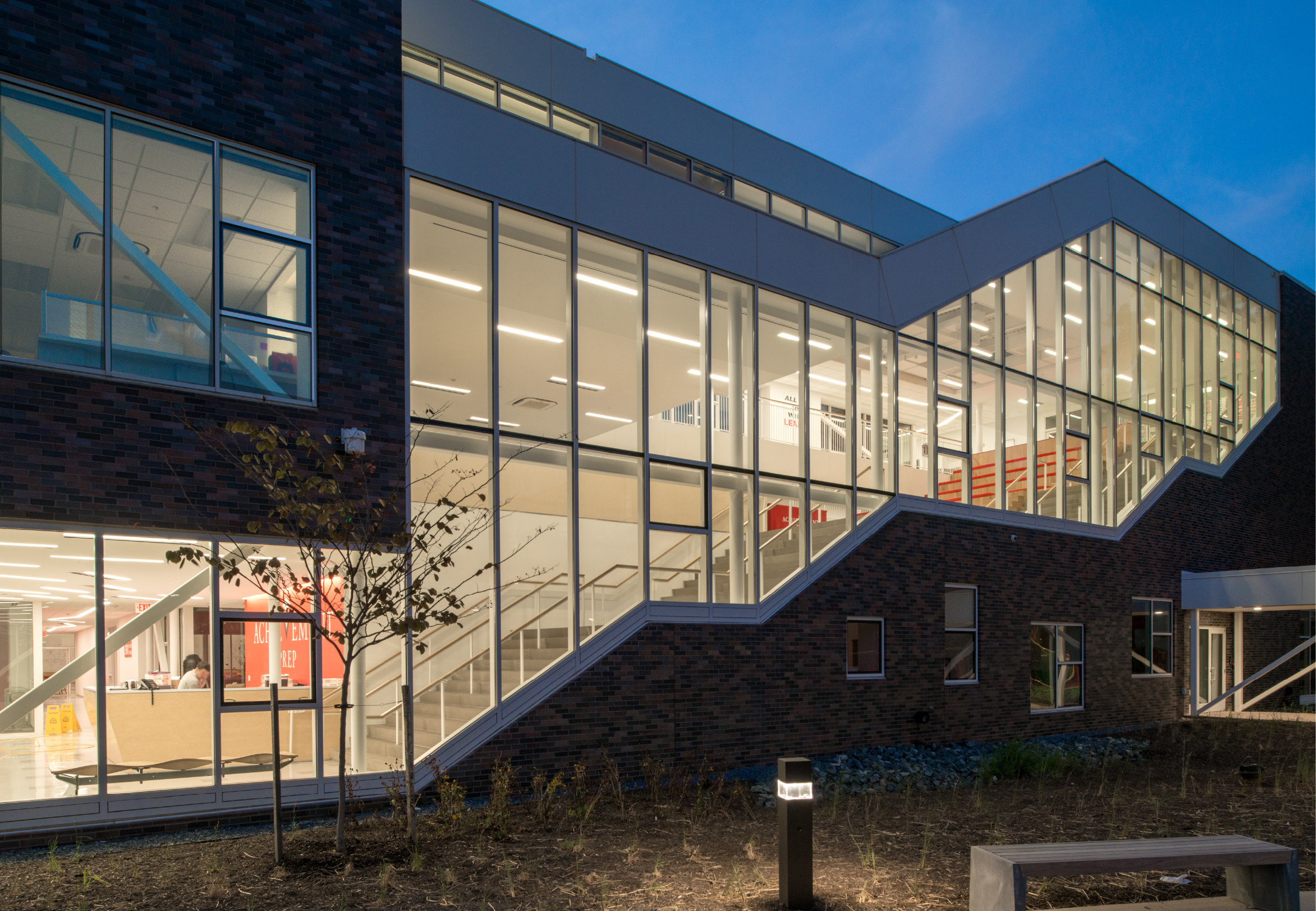
Every day students would ascend into the scholar-focused curriculum of Achievement Prep and reach new heights in their education both metaphorically and physically. With this idea, Studio 27 organized the new middle school around an axis of ascent from street to the third floor. The site stair leads to the entrance of the building with a welcoming lobby and reception desk. An interior stair continues to the second floor where the building opens into a two-story community space with tiered seating up to the third floor. This continuous axis provides both the physical connection between the floors of the building and the street, but also becomes the heart of the school. Each day Achievement Prep begins their middle school with an all-school gathering with words and cheers of motivation in the community space.
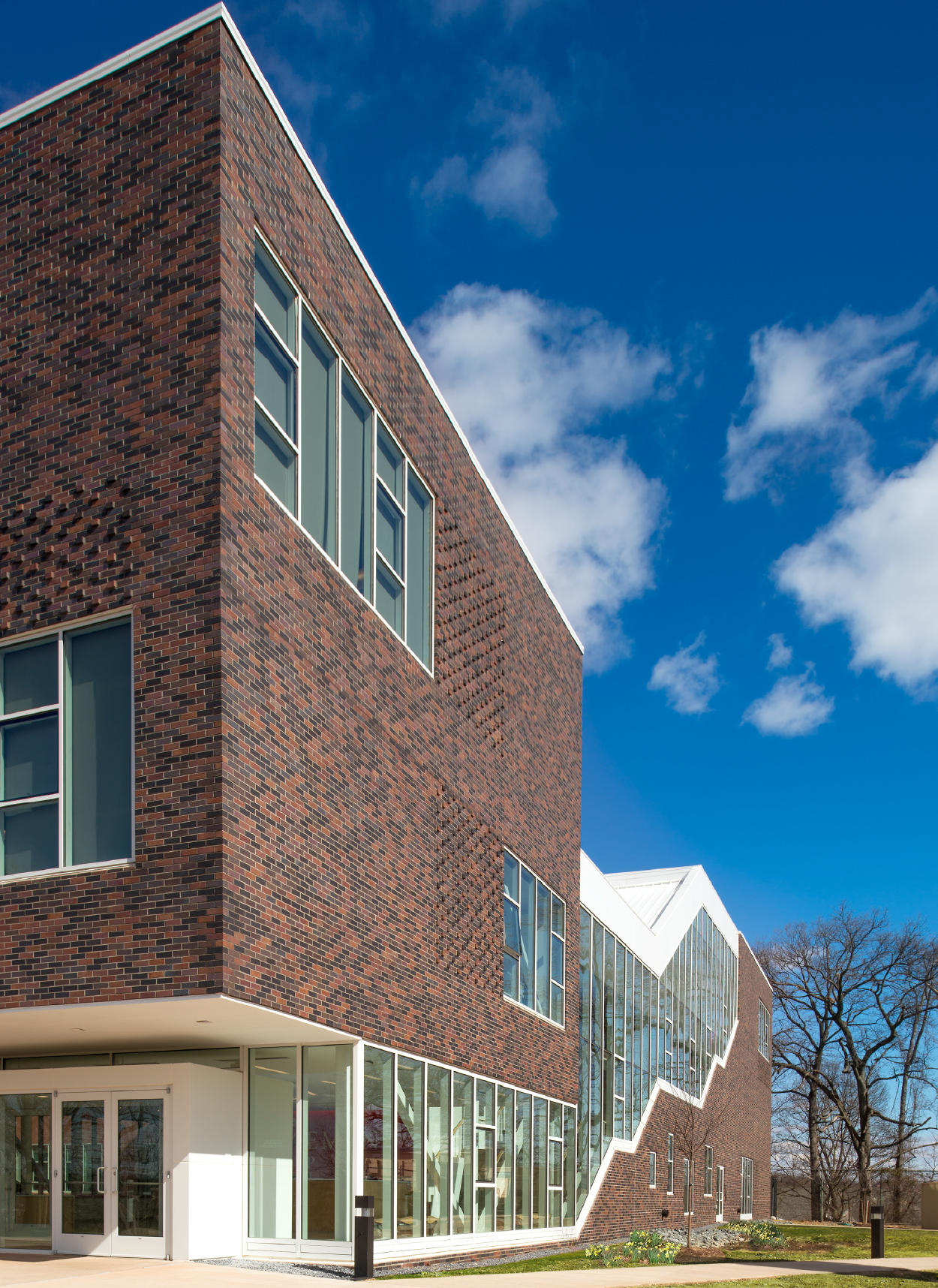
Studio 27 designs every building holistically, so naturally the main driver of the interior experience becomes the main expression on the exterior. The stair along this key axis is “carved” from the brick mass of the building and infilled with glass. This facade facing the elementary school becomes a metaphor for the future journey the lower school scholars will take as they, too, ascend to the heights of eighth grade.
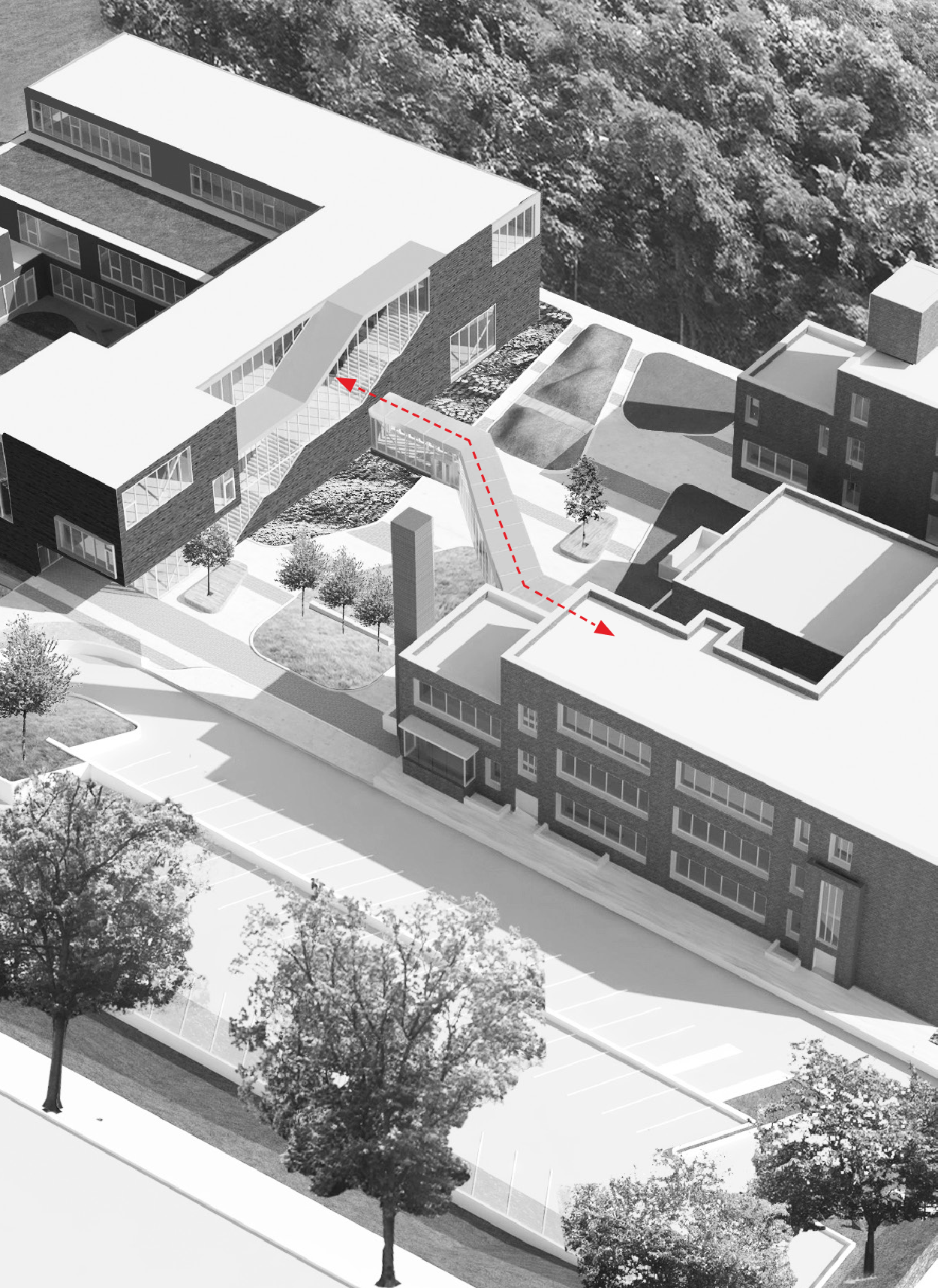

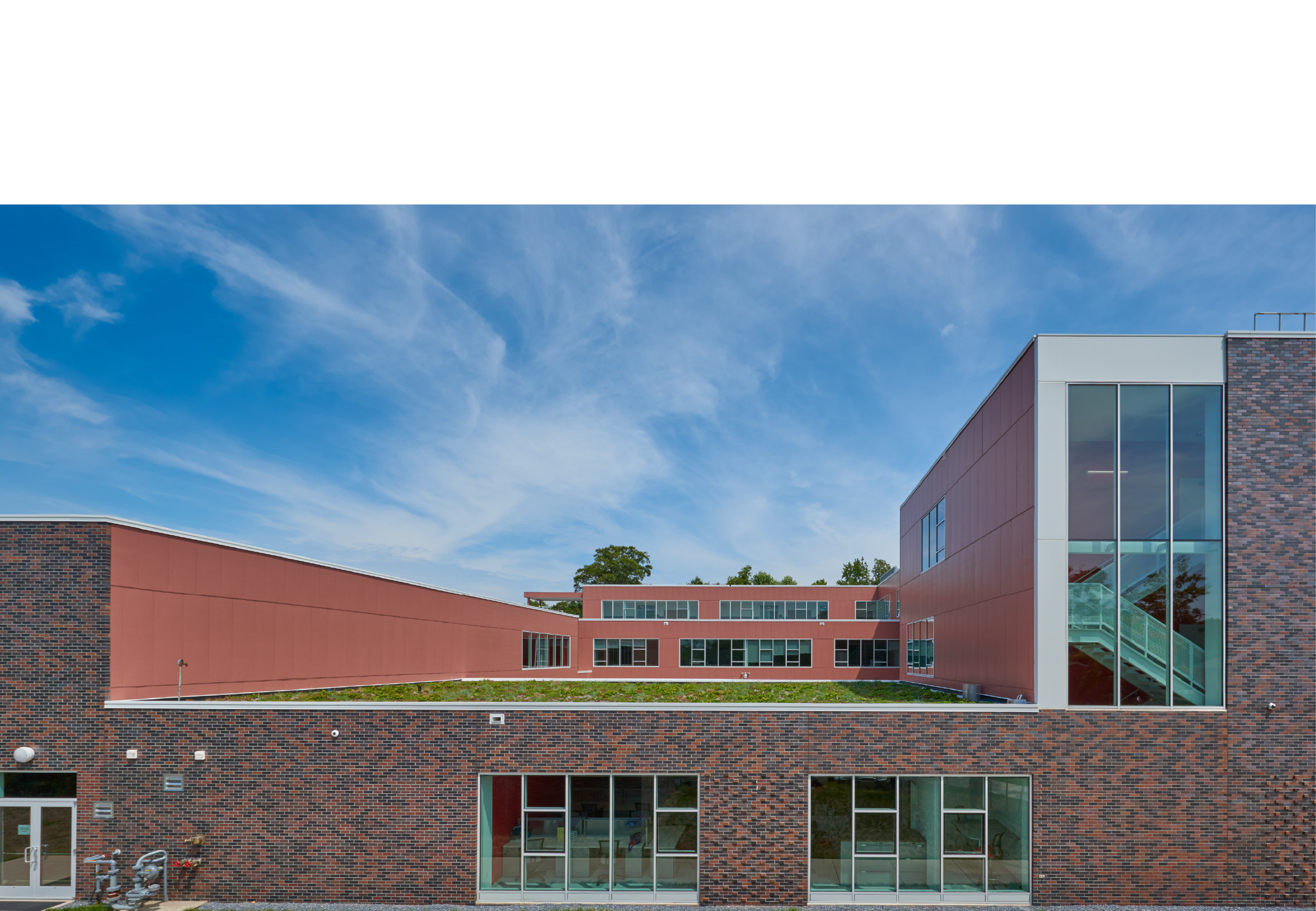
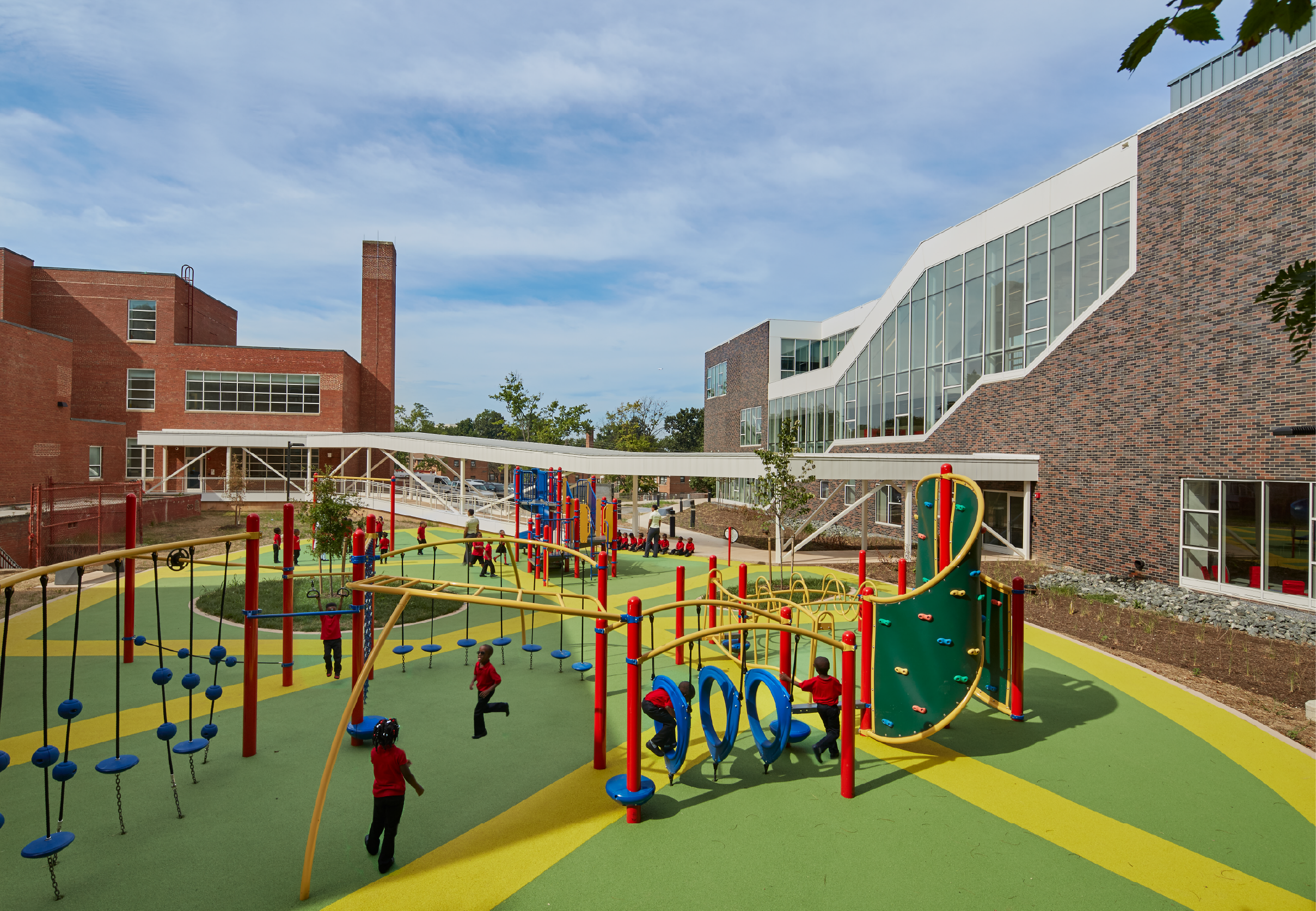
To further the idea of a campus, the massing and materials for the middle school are derived from the existing Draper School Building. The two buildings sit as equals on the plateau with the new building clad in a brick selected as a modern complement to the existing red brick. The site is organized inwards with opportunities for play and outdoor learning between and around the two buildings. A covered connection provides protected play for the elementary school and houses the utilities that connect the two buildings.
The goal of the campus was to create an architecturally unified landmark in the neighborhood that reflected the high-achieving mission of Achievement Prep. By following the quest from the site, Studio 27 was able to create a unique setting for learning rooted in the mission of the school.

Building Character Through Community
Studio 27 worked to create an interior design that reinforced the Achievement Prep identity and community. The color palette was focused on a derivative of the school’s colors showcasing the signature red color against a clean palette of white and grays. The design of the tiered community space becomes the heart of the school. Every student passes through as they navigate their school day. The tiered seating becomes an ideal setting for daily morning rallies while the quiet study area becomes a training ground for establishing good study habits.
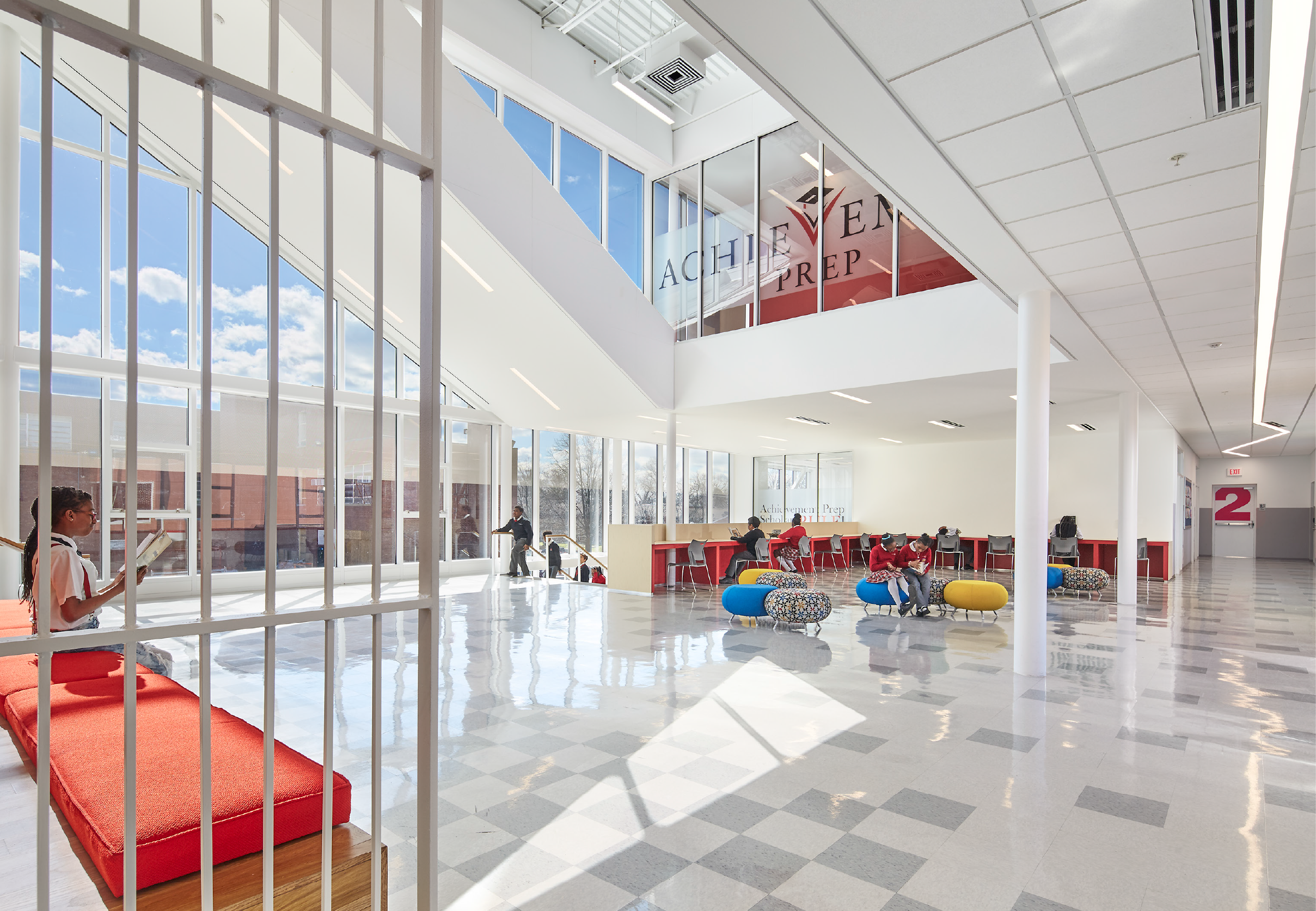
The innovative design fosters and supports a positive school culture which has a profound effect upon students’ academic achievement and social interactions with peers and adults. The school’s educational program of closing the achievement gap involves establishing habits amongst the scholars that stay for a lifetime. This includes self-discipline and an appreciation for the benefits of a college education. All reinforced by the building environment around them.
In addition to supporting the scholar’s education journey, the building design also supports the school’s innovative approach to collaborative teaching. APA staff are provided with dedicated workspace in staff workrooms throughout the building. Teachers are given focused time outside of the student environment and collaborate with one another. Students gain ownership of the classroom as teachers rotate between rooms.

Closing the achievement gap has been a persistent goal for educators and policymakers for the last 40 years. The benefits to local communities and the nation in achieving this goal are significant and self-evident. Achievement Prep’s success in narrowing this gap is founded on building strong character in its scholars. This begins with creating an environment that instills pride in student’s school and in their education: students are referred to only as scholars; scholars dress for success in uniforms of the school’s signature colors, red and black; scholars come together as a school to hear motivational words and cheers every morning; extended school hours to keep scholars in a positive learning environment.
Sustainability + Healthy Environments
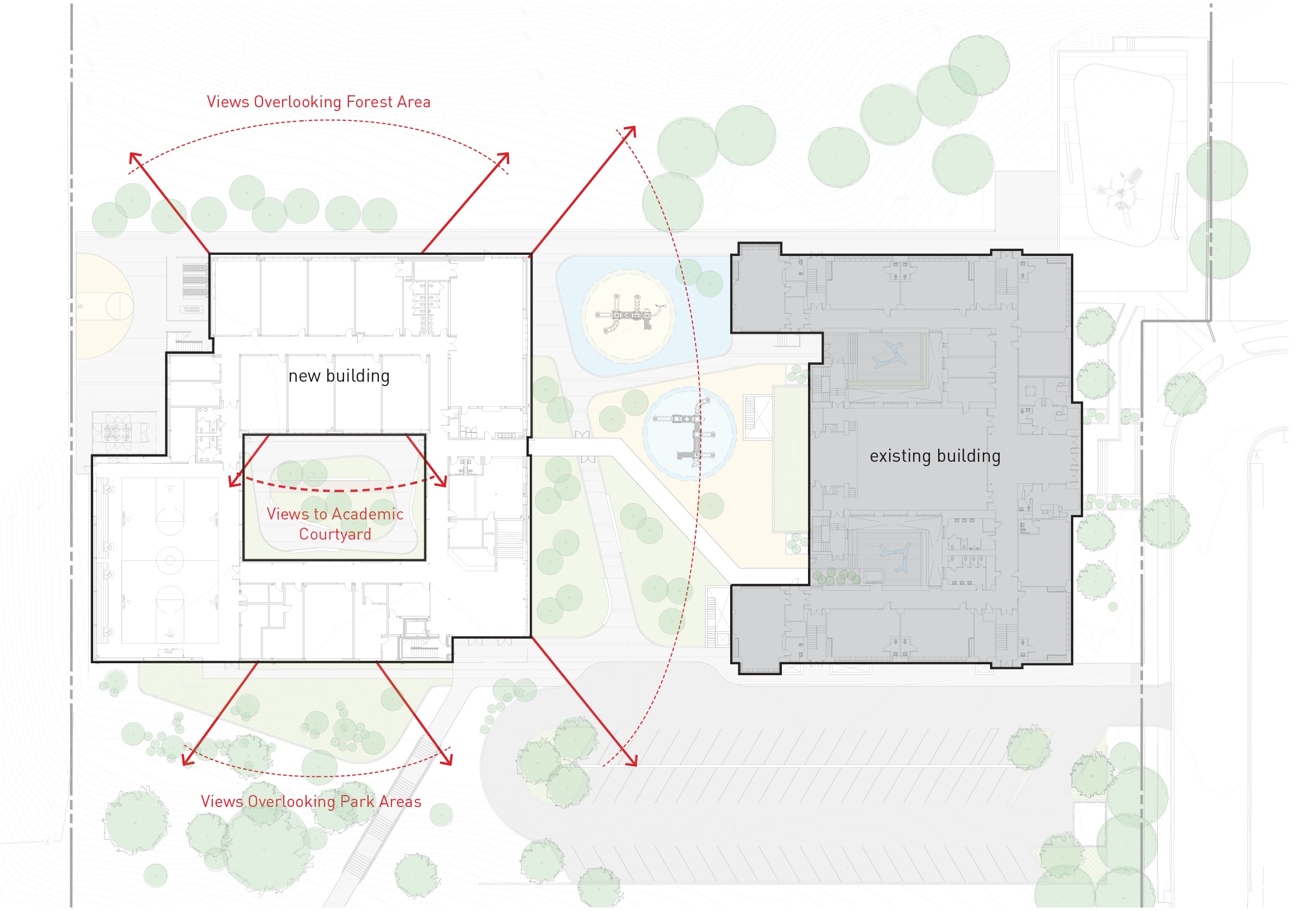
This project illustrates that environmental responsivity can be achieved economically. The LEED Gold Project achieved 37% regional materials, 75% construction waste diversion, 22% recycled content, and 80% of wood used is FSC Certified. These include rubberized flooring, carpets, and millwork, including countertops. Through daylight harvesting, energy efficient lighting, and mechanical systems, the energy performance rating is 40% above target values. The proposed energy use is 30% less than comparable ASHRAE baselines.
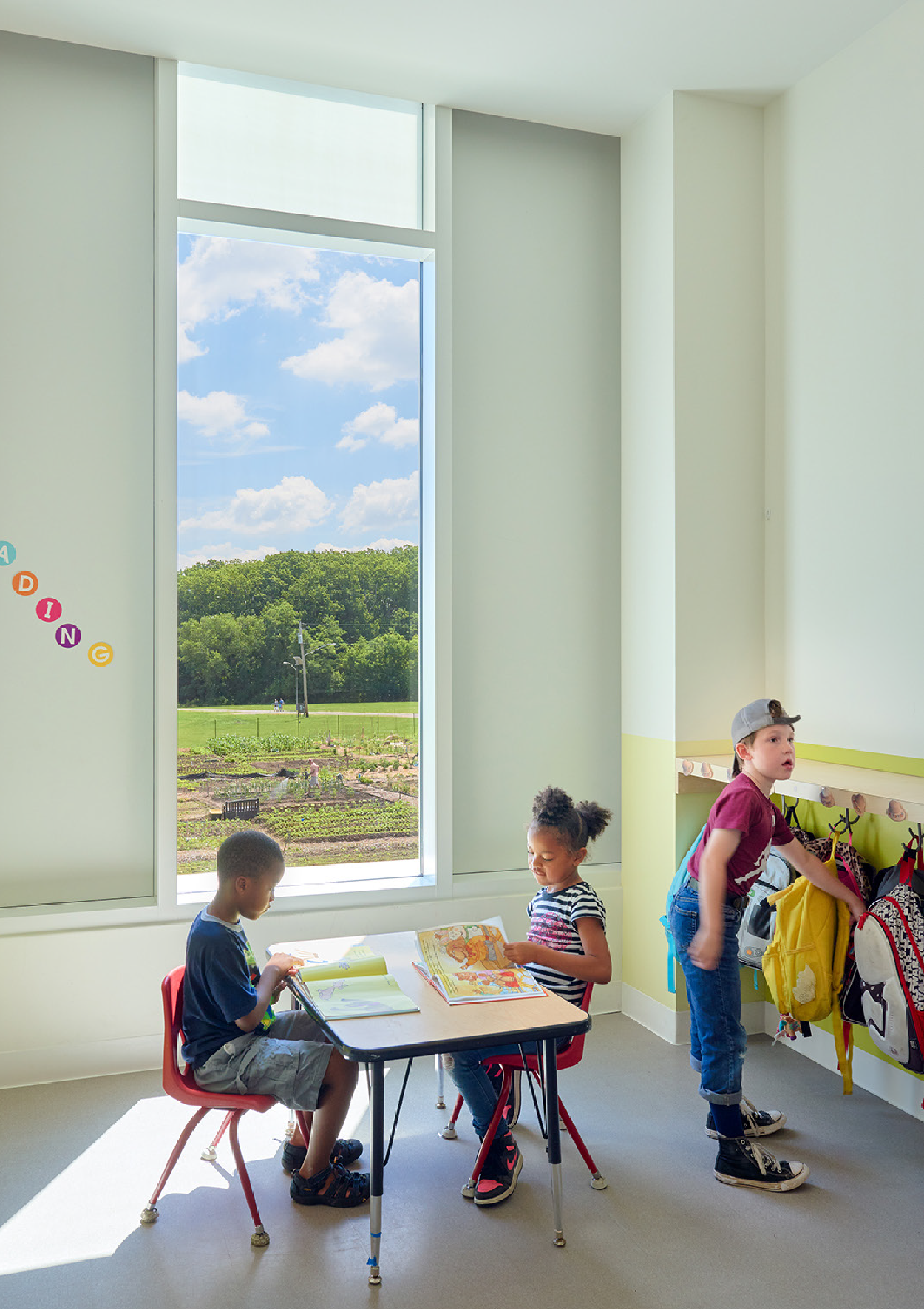
The daylight and views of the building provide a stimulating but not distracting academic environment for students. Ample natural light is allowed into classrooms. Daylighting in schools has a direct correlation to student achievement. The views out of the classroom are directly into a grove of trees. Students are connected to nature without distraction from a commanding view.

Creating a Campus
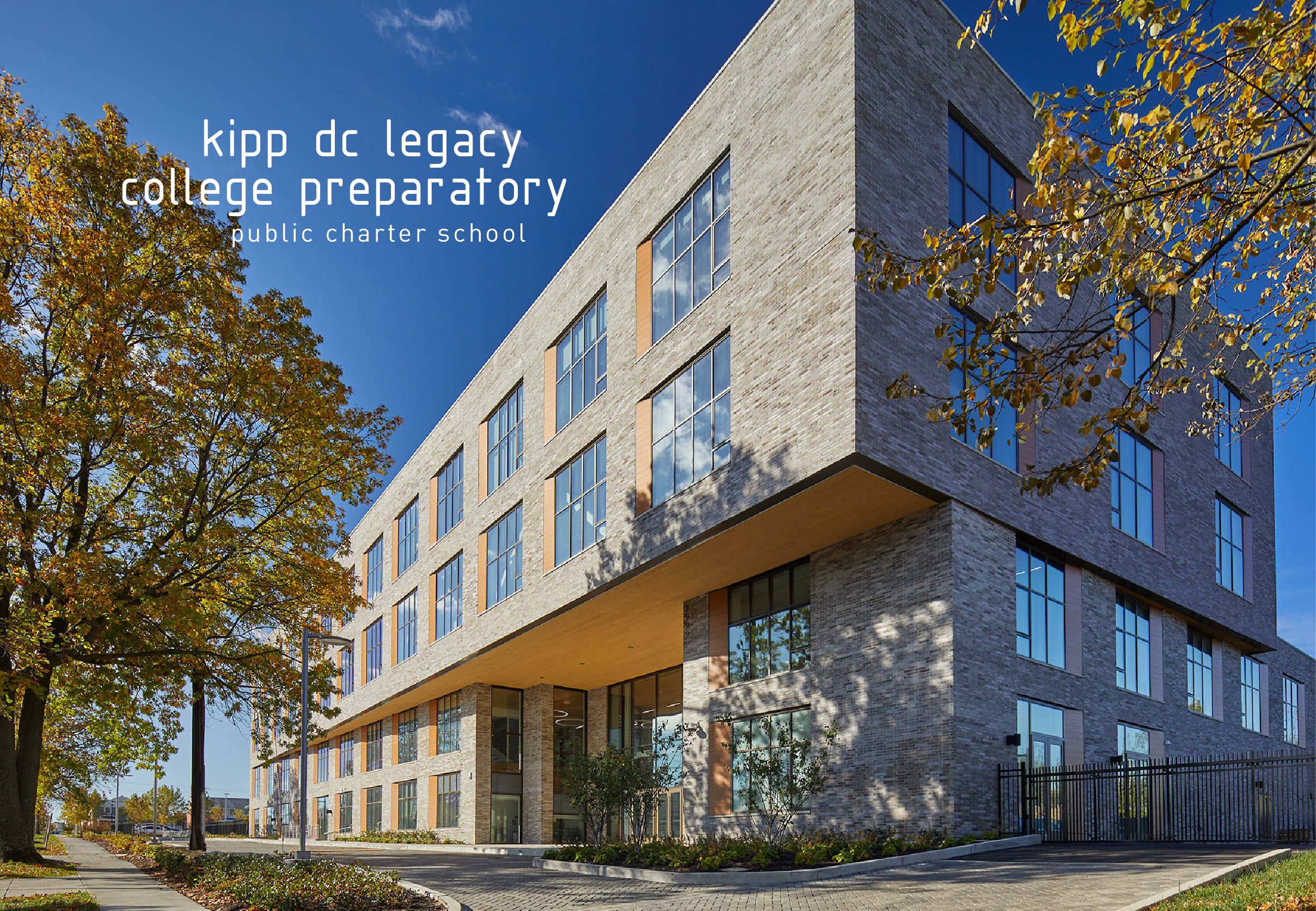
KIPP DC, a prominent local public charter school, received approval to redevelop the District-owned Legacy College Preparatory school. The site provides District residents with a new, fully modernized Ferebee-Hope Recreation Center and a high-quality public charter high school in Ward 8. In addition to the recreation center and school, the Ferebee-Hope site includes shared spaces for public meetings, community gatherings, and events.
The new state-of-the-art high school educates approximately 900 students from grades 9 through 12. It offers rigorous college and career preparatory academic programming alongside various extracurricular programs and wraparound services.
Additional programming space for the high school site includes a running track, a playing field for sports such as football, soccer, and lacrosse, spectator seating built into the topography, a small concessions building, and an outdoor classroom located within a bio-retention area.
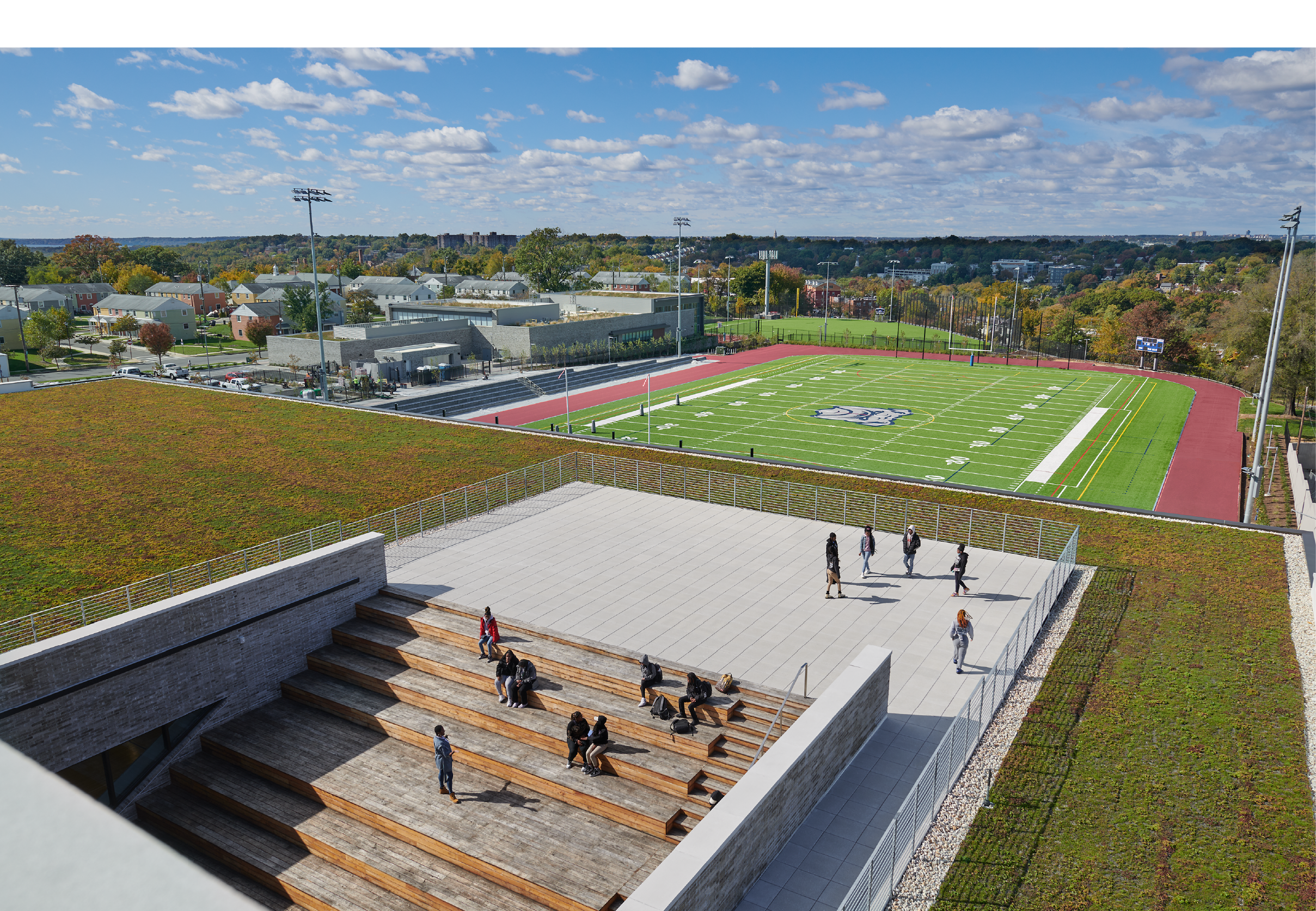
Back-of-house programming includes the gymnasium, cafeteria, lecture hall, and outdoor terrace. The regulation-sized gymnasium features high-performance LED lighting, and the outdoor patio features a floor-to-ceiling, high-performance, glazed storefront window system that enables views of the gym and the lobby below. The inviting space is a large student commons seating area that overlooks the fields.
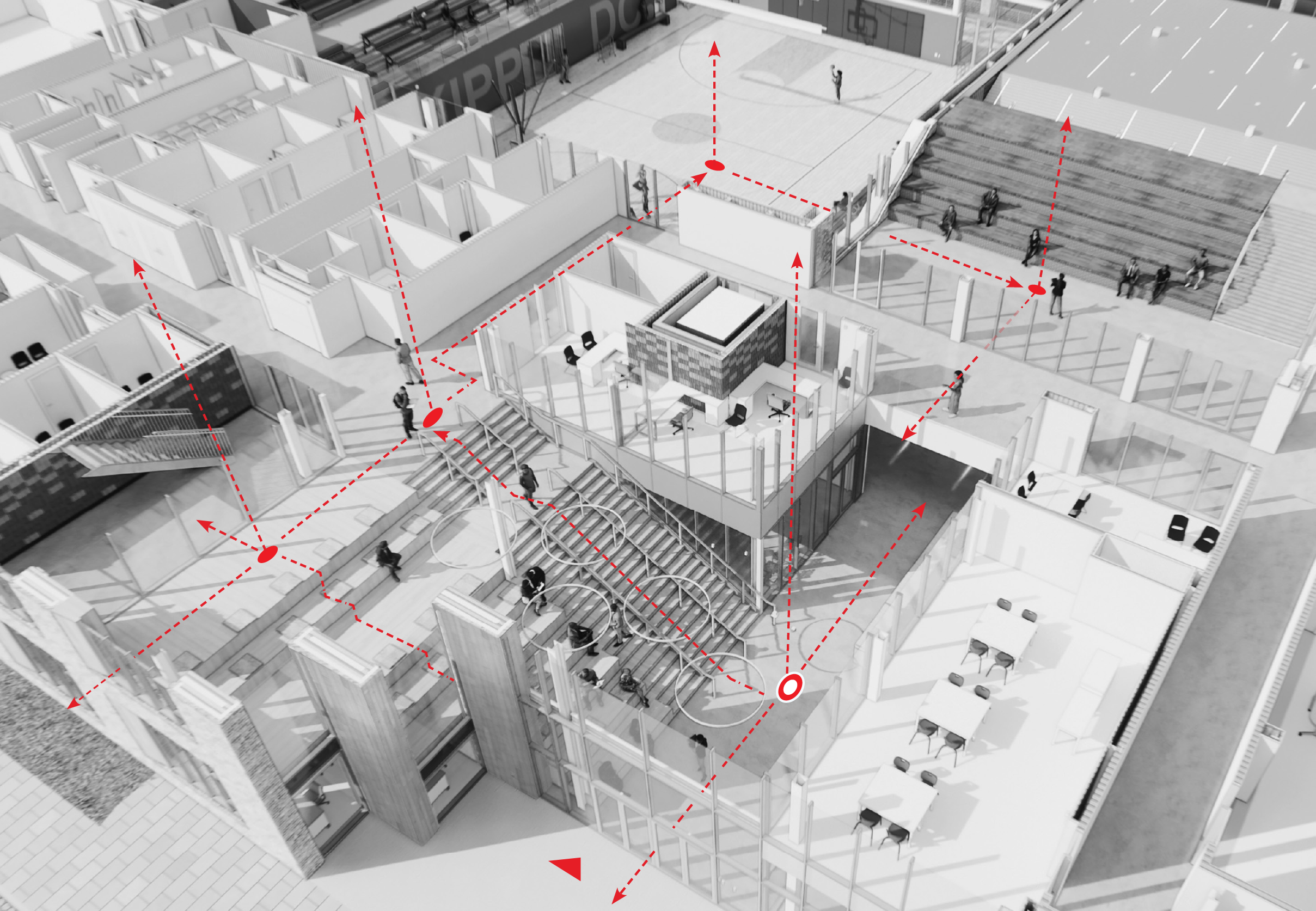
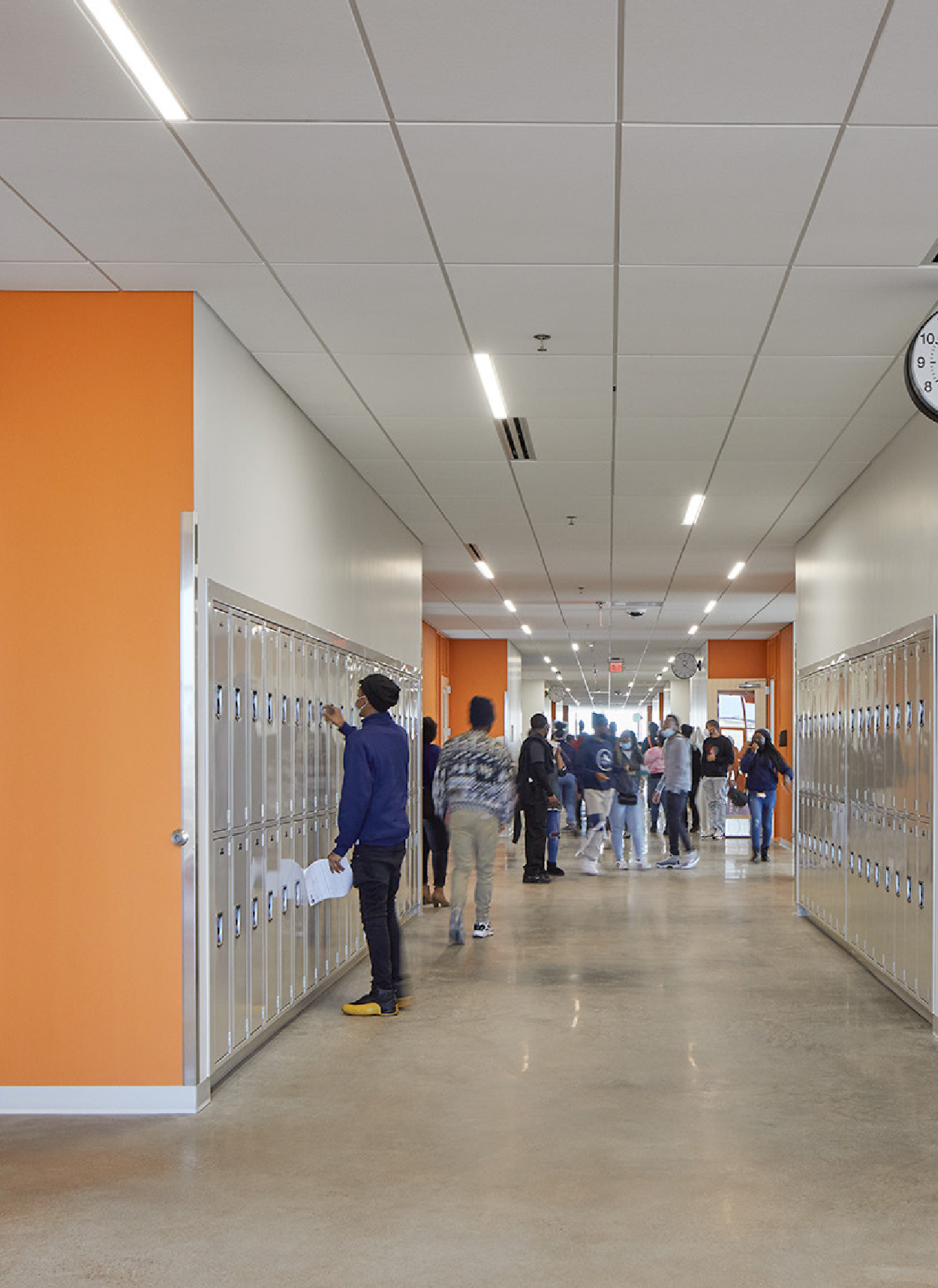
Colorful wall panels are used to identify major spaces within the building and help with wayfinding while balancing and controlling sound in these spaces.
Walls are painted gypsum board, floor finish is polished concrete with rubber wall base to match. Commons seating and reception desk are wood veneer.
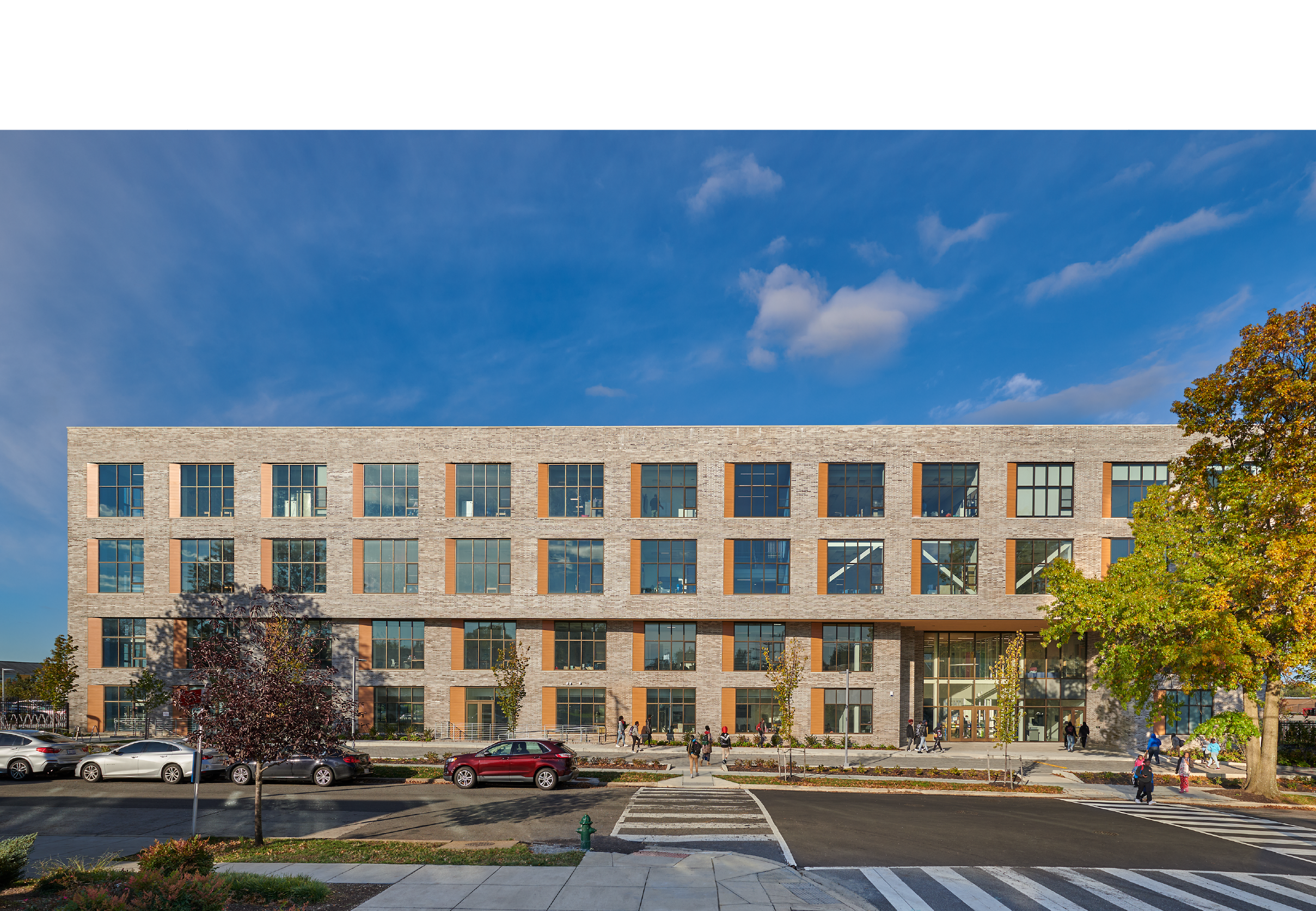
Attractive, durable, and easily maintained finishes are always challenging in a high school project. Brick cladding is durable, long lasting, and requires little maintenance. Wood cladding is used at major entrances, adjacent to windows, and at gathering spaces to add warmth and integrate interior and exterior spaces. Entrance doors have durable, intruder-resistant hardware. Glazing is bullet-resistant or has applied security film. All visitors pass through a security vestibule to be greeted, screened, and badged prior to entering building.
From Office to School
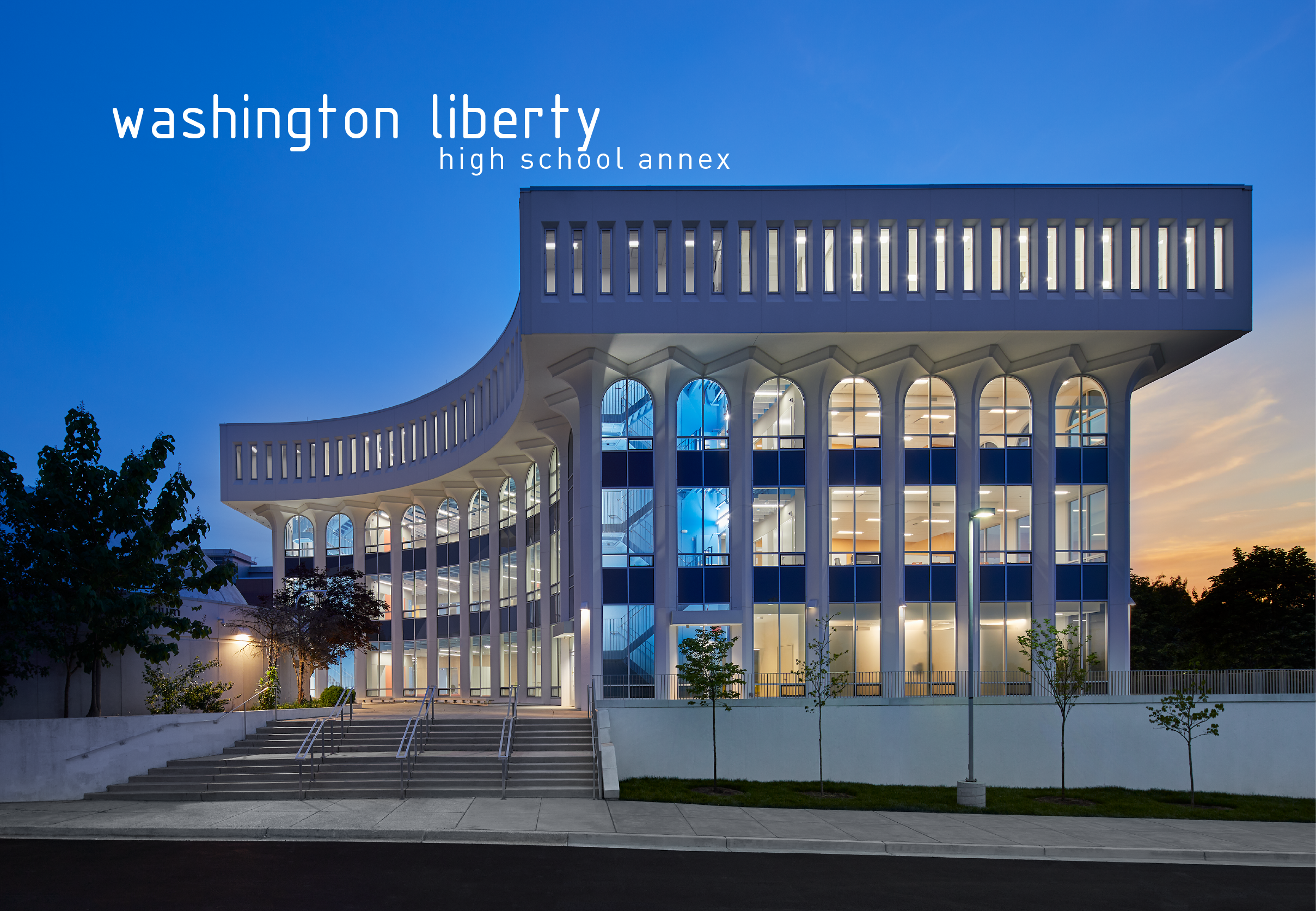
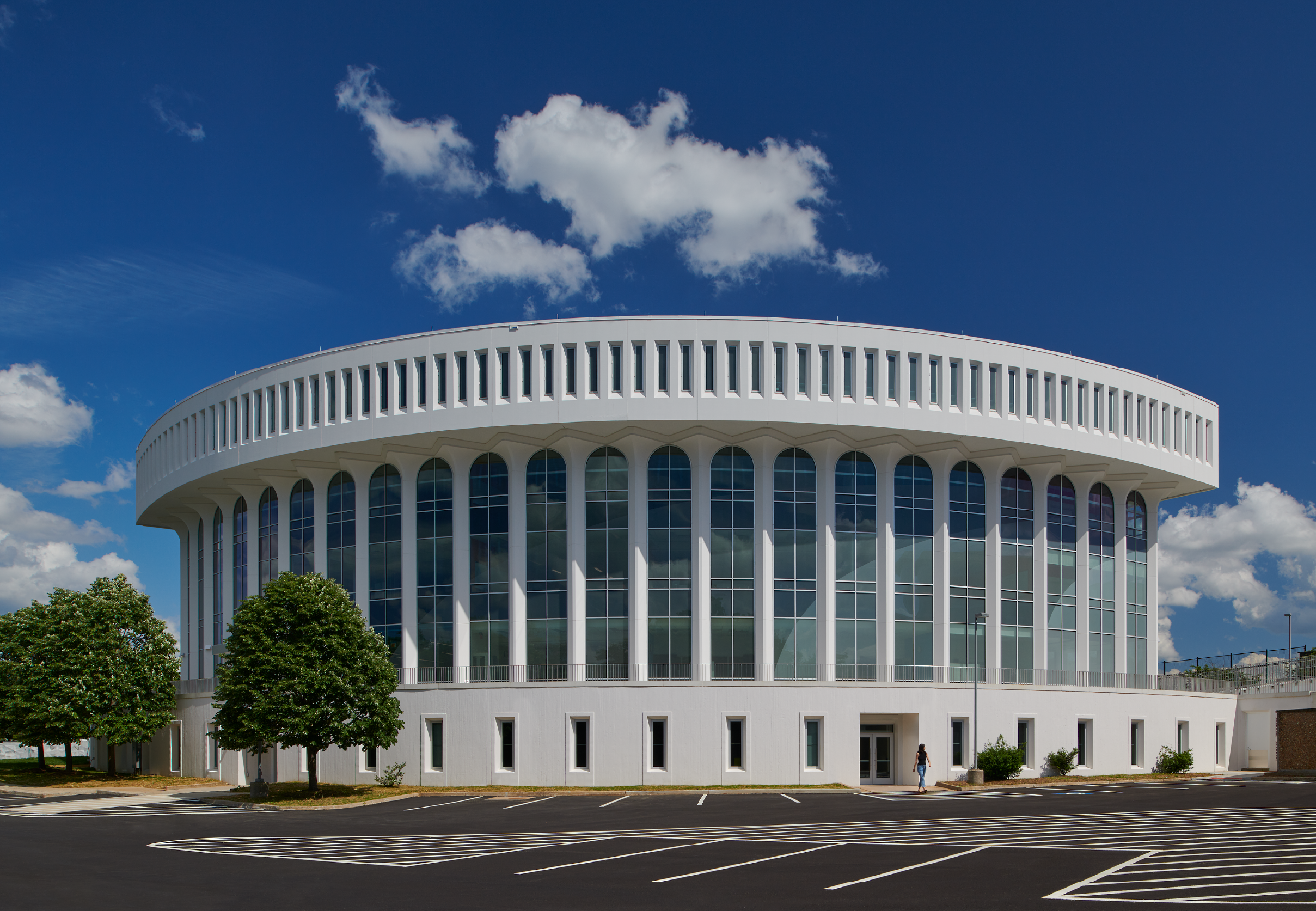
This comprehensive renovation for Arlington Public Schools converted an existing 55,000 square foot 1968 municipal building into a state-of-the-art high school annex. The project expands the capacity of the existing Washington Liberty High School on the same campus. The Annex building opened in 1969 and served as the Arlington Education Center for over 50 years. Regardless of all the wall curtains, the five-floor, 55,000 square feet facility felt cramped, dark, and dilapidated due to its layout.
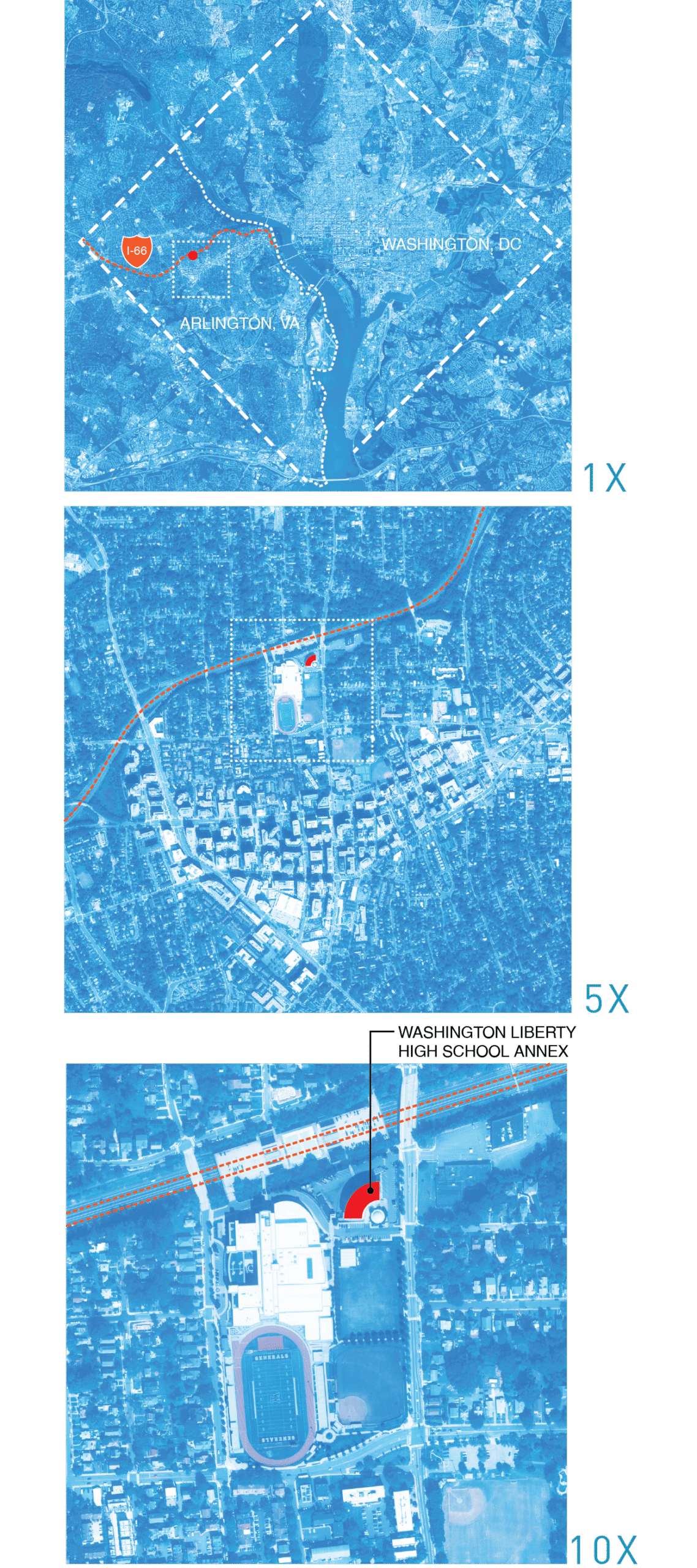
Geographically, Arlington is the smallest county in the country. Located in Virginia across the Potomac River from the District of Columbia, it was established in 1846 when the federal government retroceded its territory south of the Potomac back to Virginia. As a densely populated hybrid urban-suburban county, Arlington has a continually growing student enrollment but without open space available in which to build new schools. As a result, the county is seeking other alternatives including the conversion of old spaces to educational use.
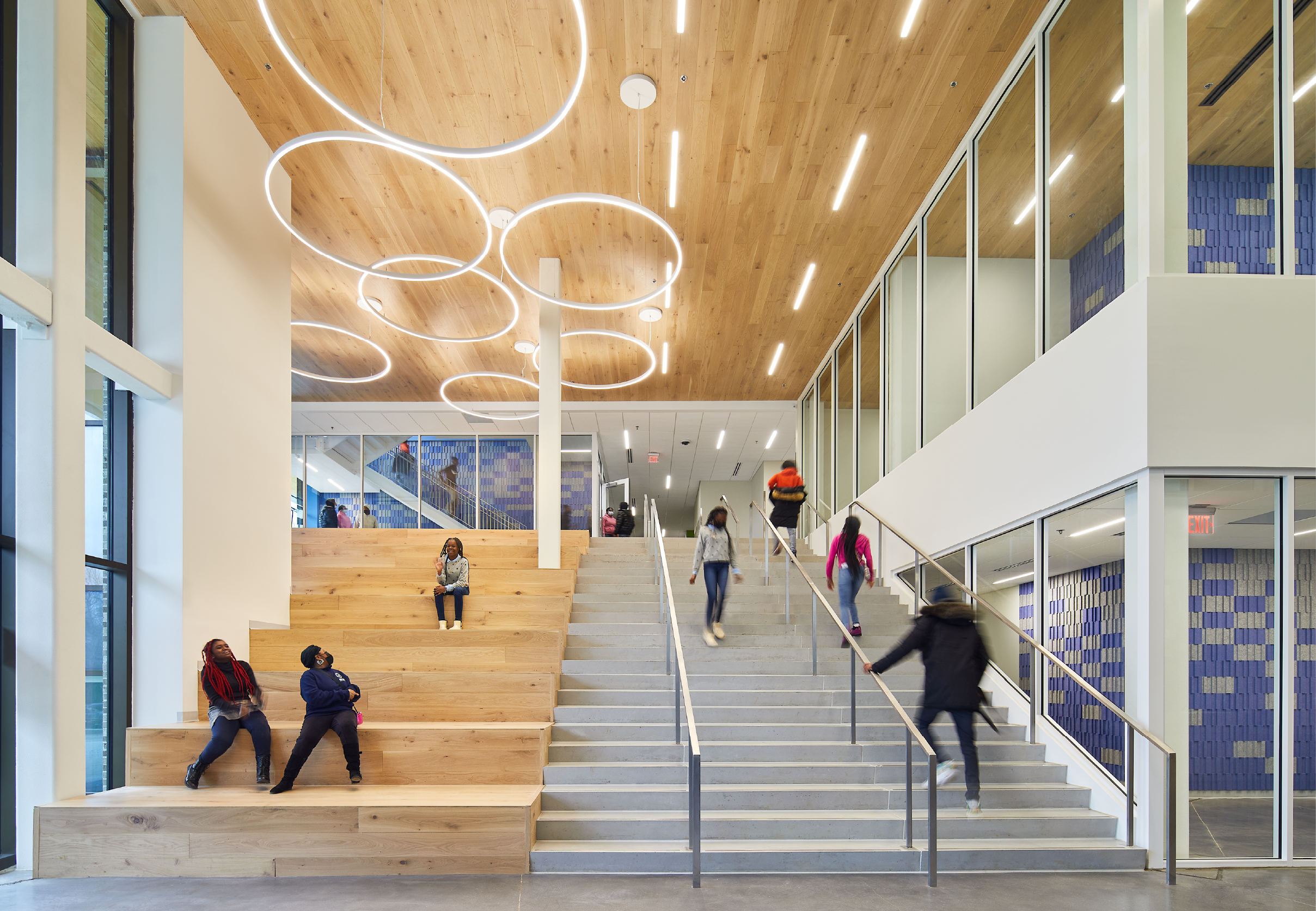
The Washington Liberty High School Annex converts an iconic 1960s era organic form office building into a 600-seat educational space.
Currently used as an annex for the high school with which it shares a campus, the design of the building is open to conversion to an elementary or middle school in the future if desired.
Changing the Core
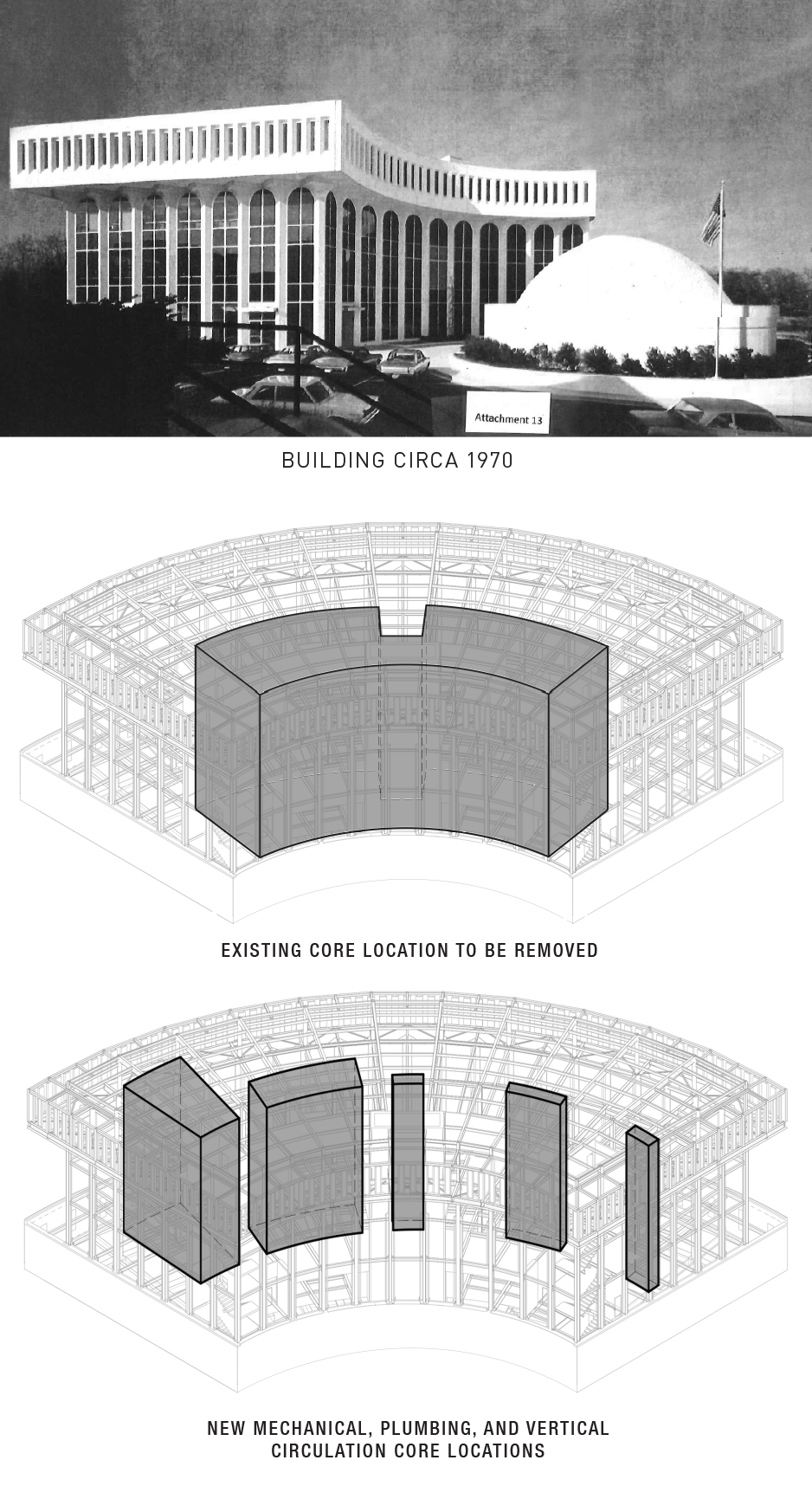
The existing building cores, containing stairs, vertical mechanical spaces, bathrooms, were located all on the inside curve of the building. In the new layout, the cores are moved to the center of the building, allowing daylight into all of the student spaces and to facilitate program.
The design of the building with minimal load baring interior partitions beyond the shell of the building allowed it to successfully serve as the administrative headquarters of the school for over 50 years and afforded a relatively easy adaptive reuse for student programming.
A New Plan Organization
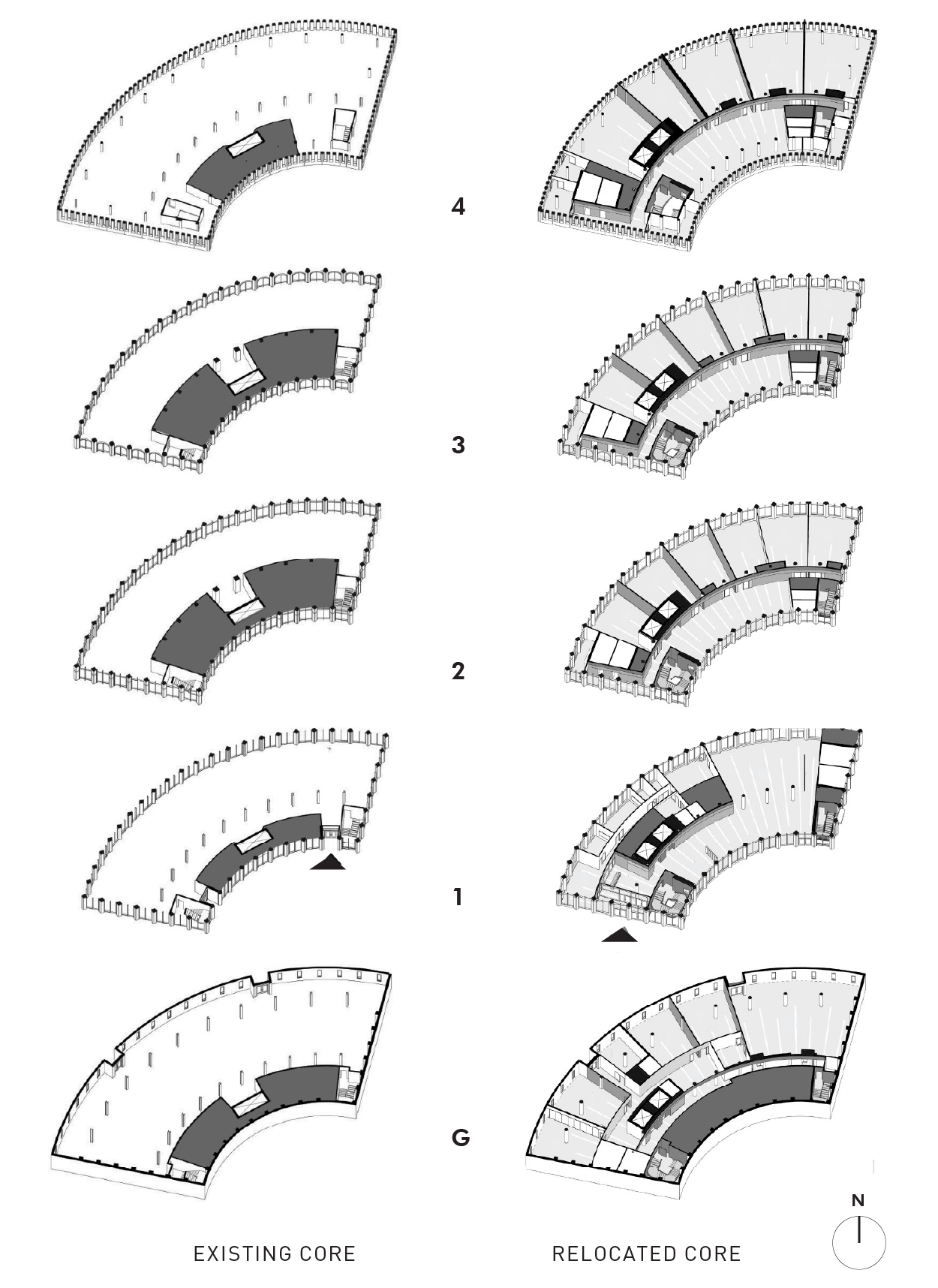
The concept of the renovation was to convert the existing floor plan into three different zones. The outward curve of the arc consists of the private classroom, followed by the circulation space, and the public spaces are along the inner curve.
The first step was to remove nearly all the interior partitions and start with an empty floor plate. Secondly, the interior of the building did not comply with current building regulations and needed to be brought up to date. A new staircase and sprinkler system was required to meet the fire code, and new elevators were required to meet with the Americans with Disabilities Act of 1990 (ADA).
The shape of the building is an arc with a spherical dome planetarium in the center. The planetarium was used as a radius point with grid lines extending from that point to form eleven equal steel wedge-shaped sections in the main building.
The concept of the renovation was to convert the existing floor plan into three different zones. The outward curve of the arc consists of the private classrooms, followed by the circulation space, and the public spaces are along the inner curve. The design allowed for a cost-effective renovation with very minimal changes to the existing floor plates and structure. The major changes included construction of a new stairwell and elevators to meet building codes and ADA regulations. The money saved allowed the school district to invest in state-of-the-art equipment for its students.
Each floor consists of a similar layout, except for the ground floor. The elevator shaft was relocated to establish a relationship between private, circulation, and public spaces. The ground floor is comprised of offices, conference rooms, and new physical education spaces. Smaller classrooms were set up to be used as multi-purpose studios.
Shared Use Space
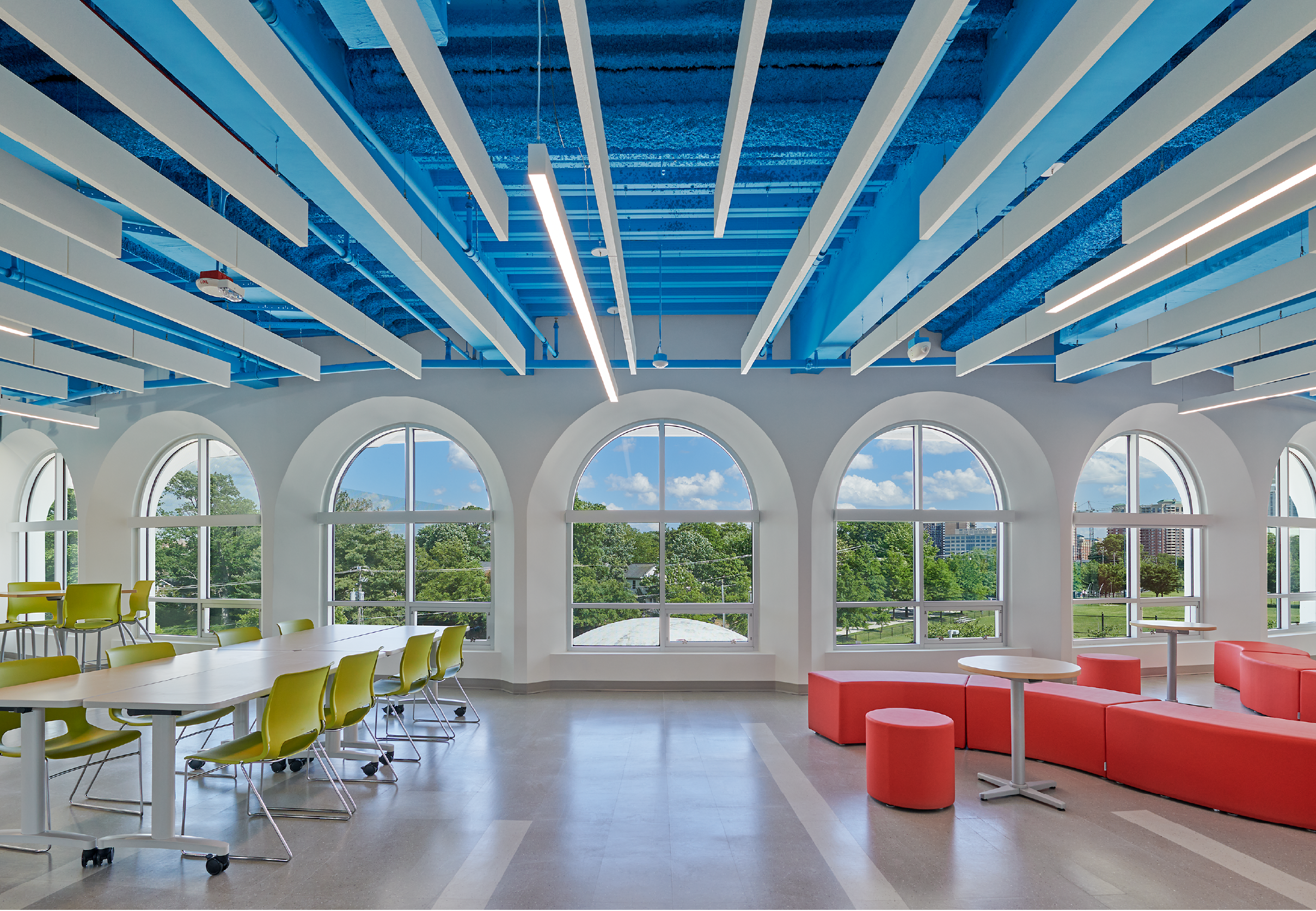
With its abundant collaborative learning spaces, the building supports Arlington’s desire for a new educational pedagogy. No longer are the classrooms the only container for learning. The design allows for learning to flow unobstructed from classrooms to flexible learning zones furnished to facilitate independent study or group collaboration. Programming includes classrooms, collaboration spaces, workout space, science labs, and office spaces, as well as alterations to the building envelope and replacement glazing systems.
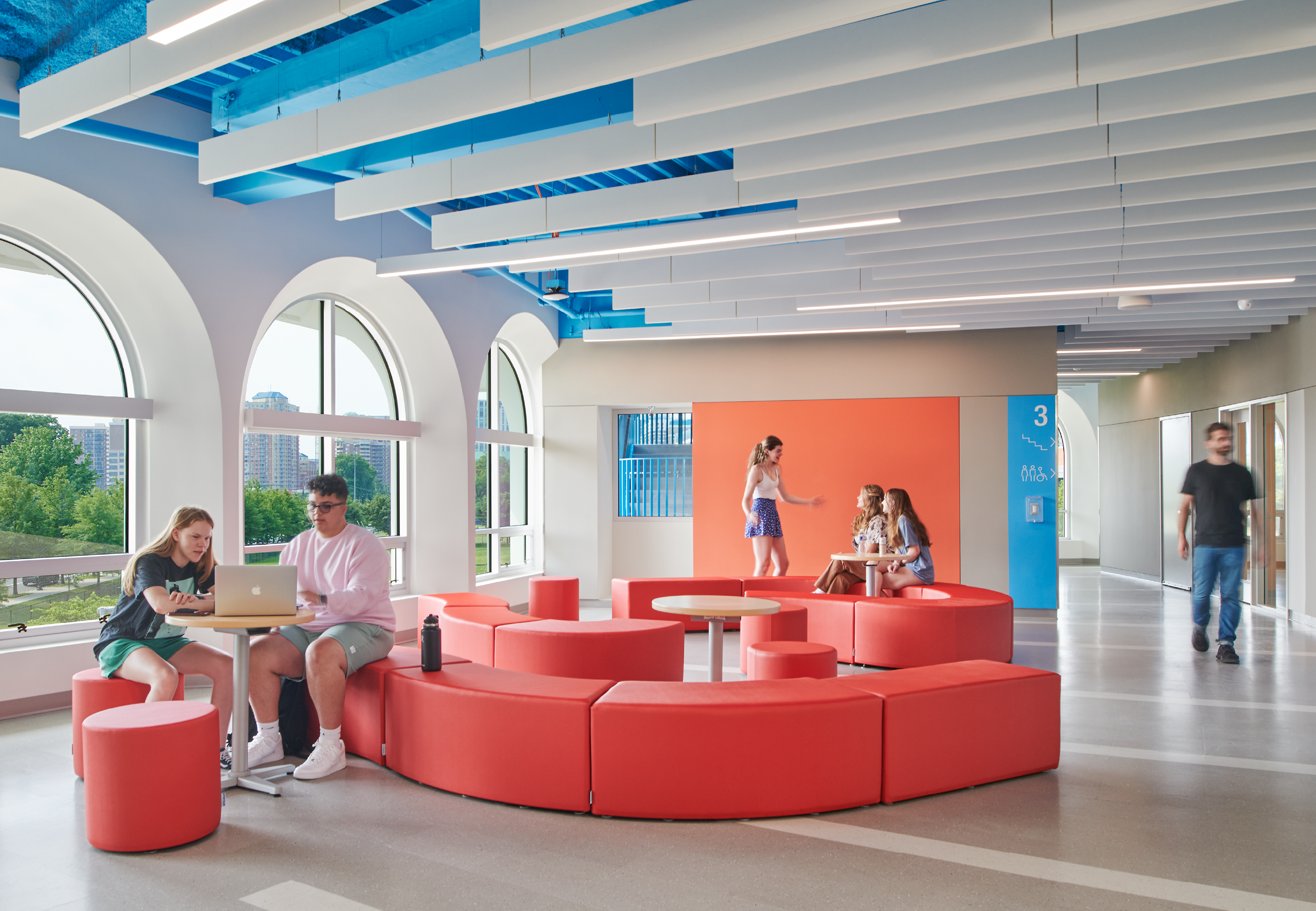
The Typical Classroom
Mechanical systems were moved outside of the classroom area to eliminate disruption and prevent noise pollution. This move helped the building earn a point for LEED certification. The ceilings are paneled and painted white and blue to simulate a clear, puffy-cloud sky. The facility also consists of an updated security and lock down feature that includes pull-down curtains that completely obscure views, push bottom locks on doors, and the ability to secure the entire building with a push of a single button. This office turned into a classroom building helped the school expand without sacrificing students’ experience.
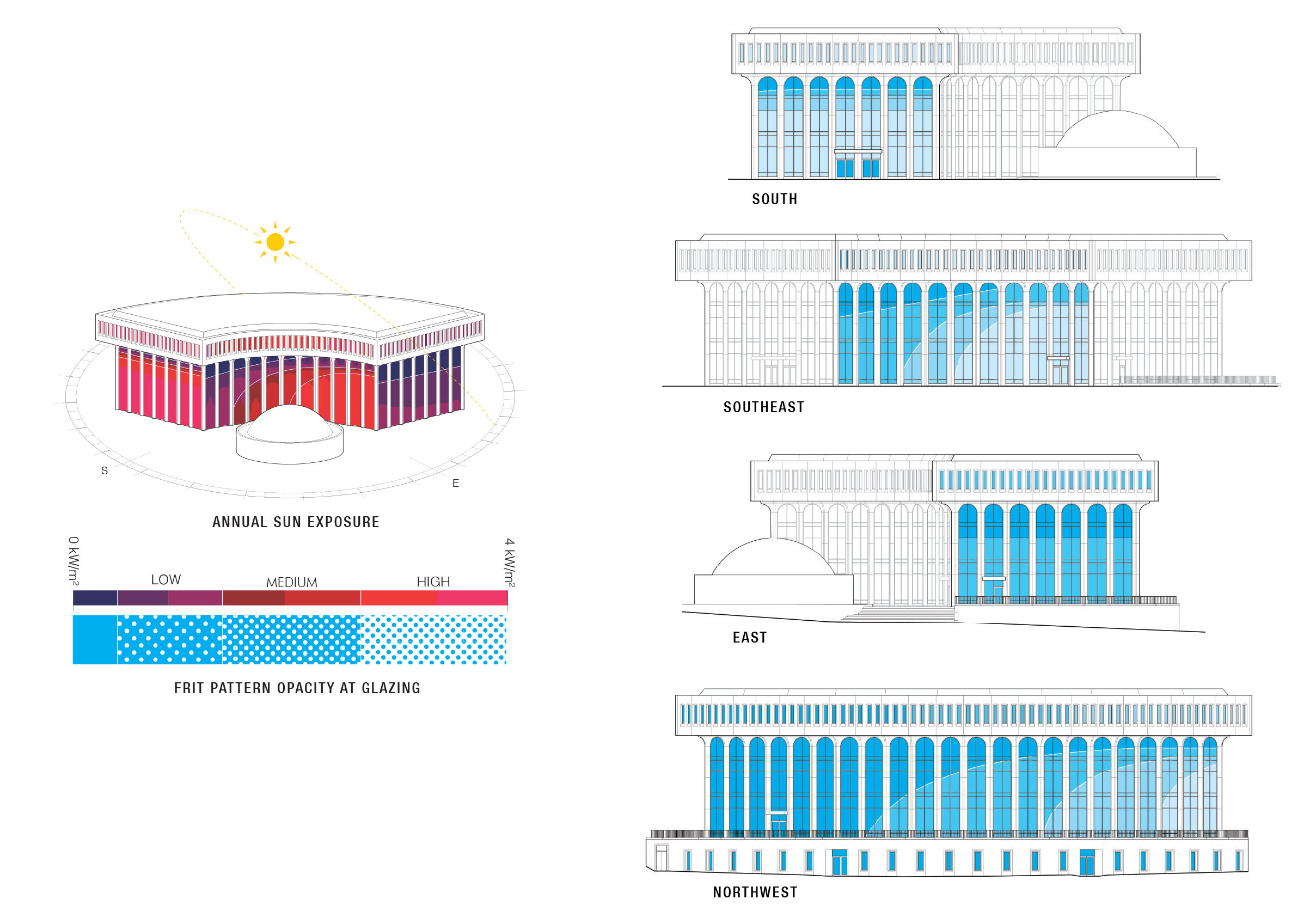
Modernizing 1970 Glazing
One of the challenges of converting an office building to school use is the overabundance of glazing found in an office building. The new glazing system includes a graduated frit pattern that offsets the solar gain on each elevation of the building. This fritted pattern follows the path of the sun with the density of the frit varying depending on where the glazing receives the most sun exposure over the course of a year. The frit is located on the second layer of glazing reducing solar gain and visual glare on the interior while maintaining the fenestration pattern of the building’s original design.
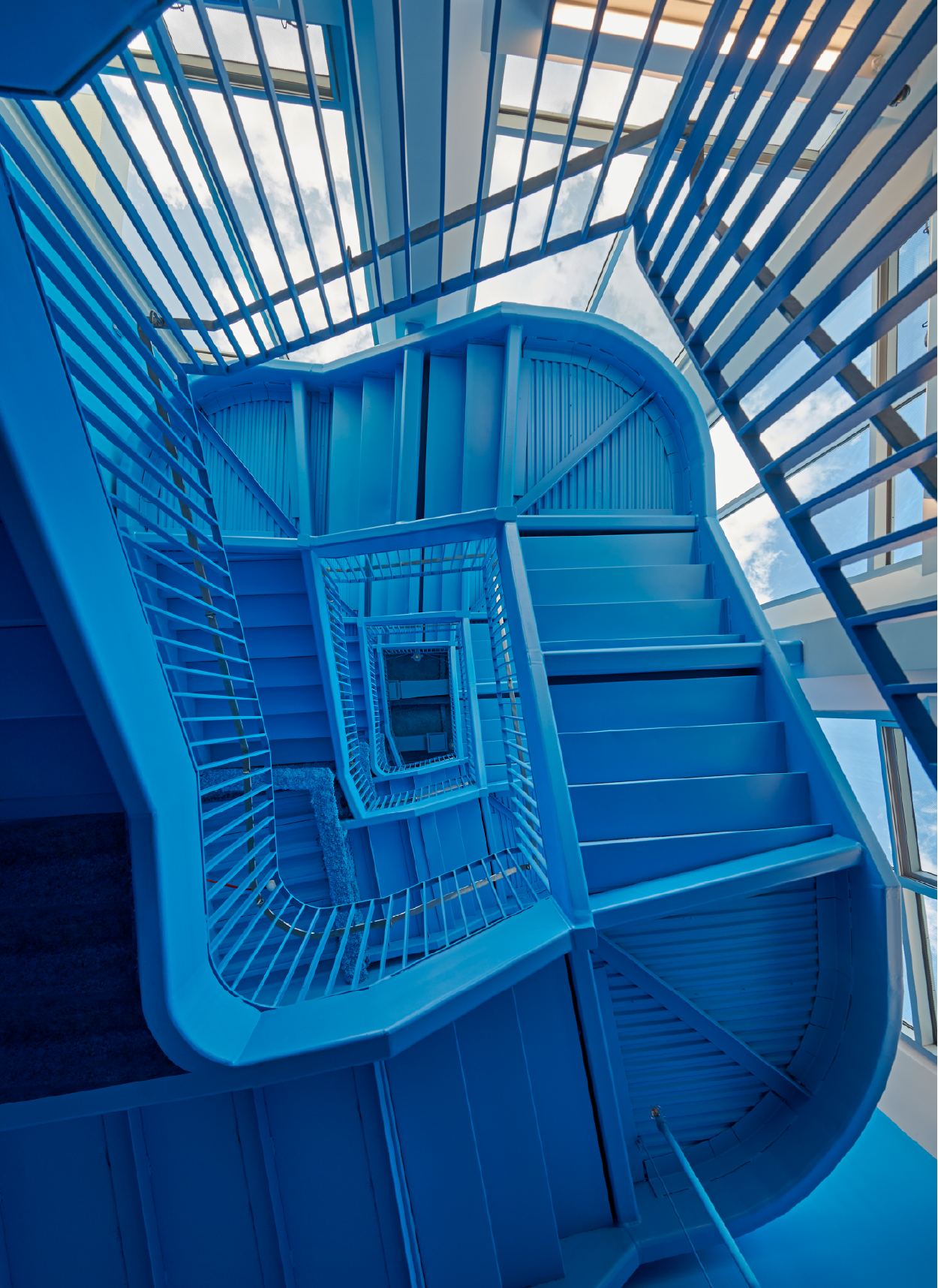
Moving Through the Space
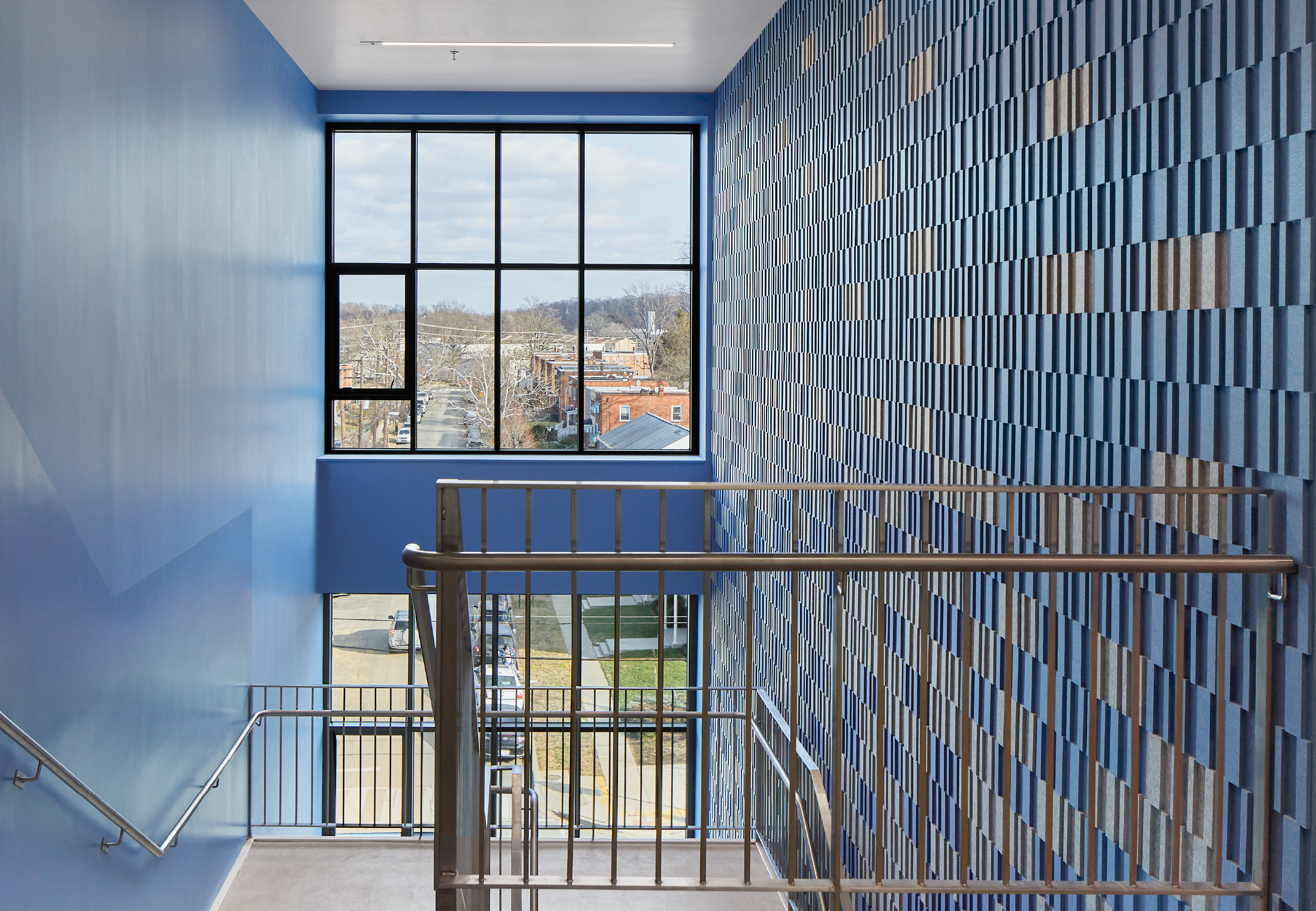
How do you move 500 students through a former five-story office building? You carve out space for a new, wider, curvaceous stair with plenty of natural light. The stair appears to spiral in suspension with concealed structural support.
A new communicating stair.
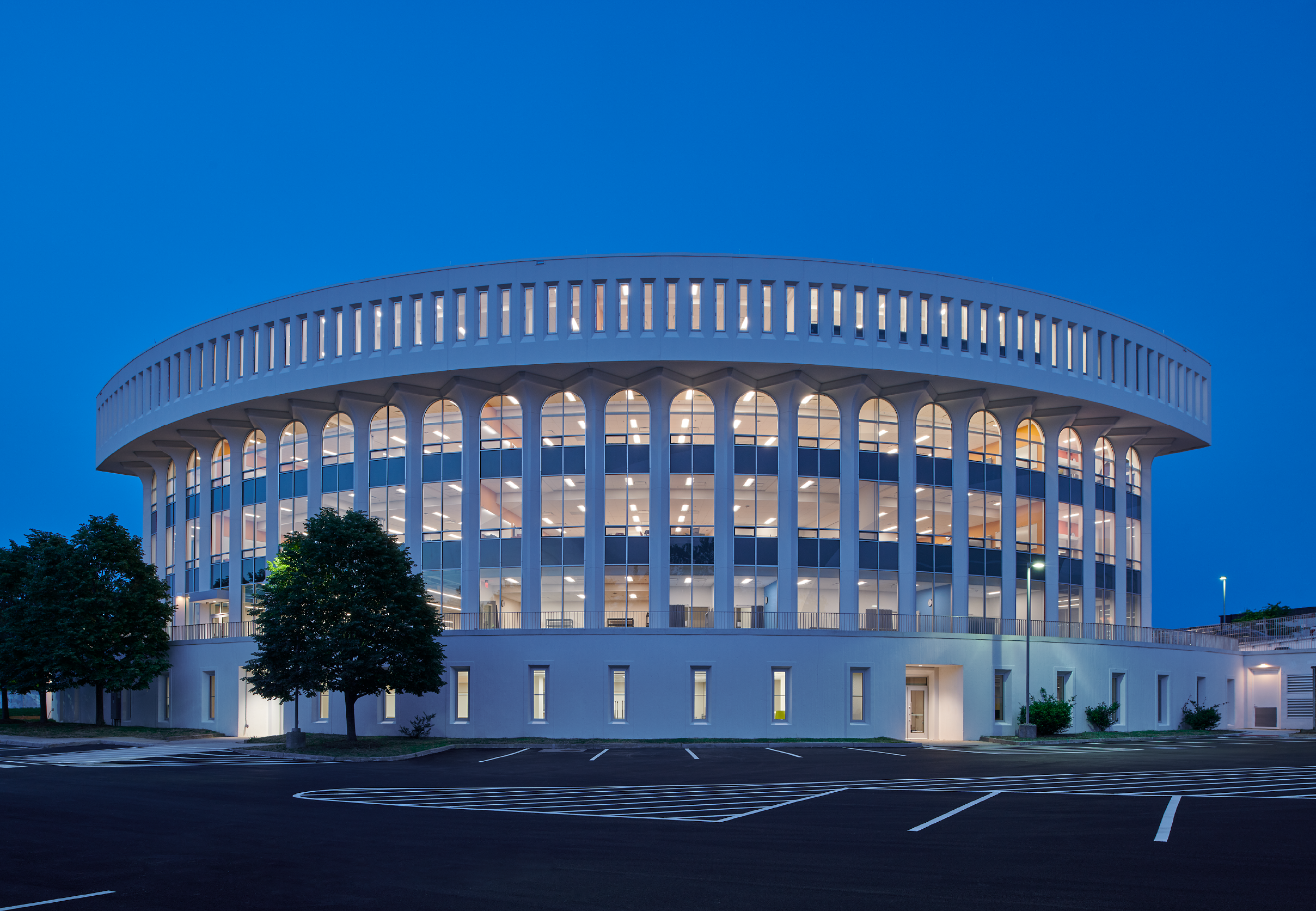
A New Take on Learning
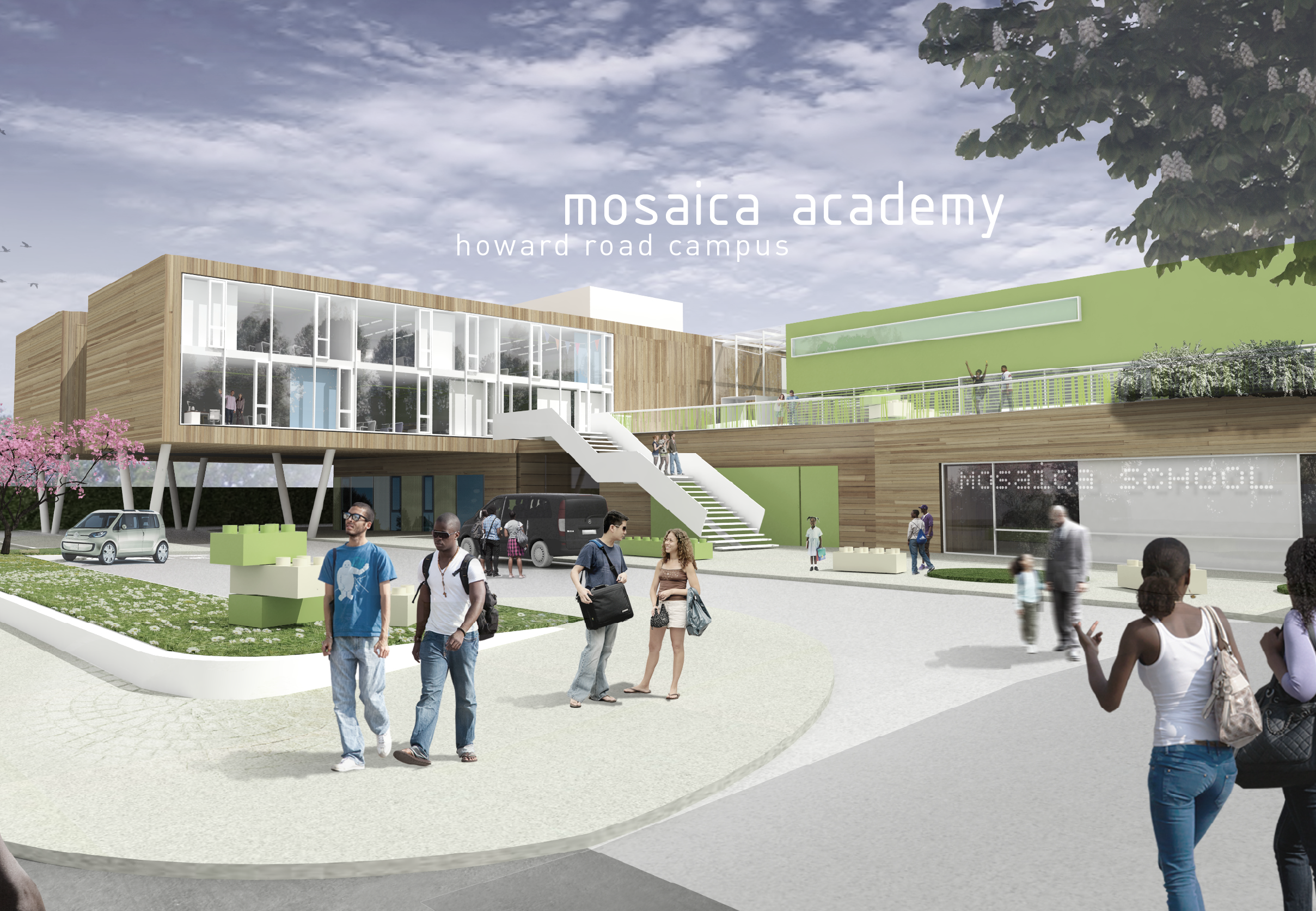
Mosaica Academy is a new charter school located in southeast Washington, D.C. The site is contained by a major urban thoroughfare, an on-ramp to 295 and off-ramp from South Capitol Street. The design of the school is based on the Paragon Teaching Method employed by the school, which replaces traditional history and social studies curriculum. The school program encourages students to gain a historical understanding through the chronological study of the evolution of world cultures, encouraging them to identify associated interrelationships and develop a larger picture of history as opposed to memorizing isolated events.
The building is designed to exemplify the Mosaica teaching model and physically represent the program inspired within each space.
Play + Performance
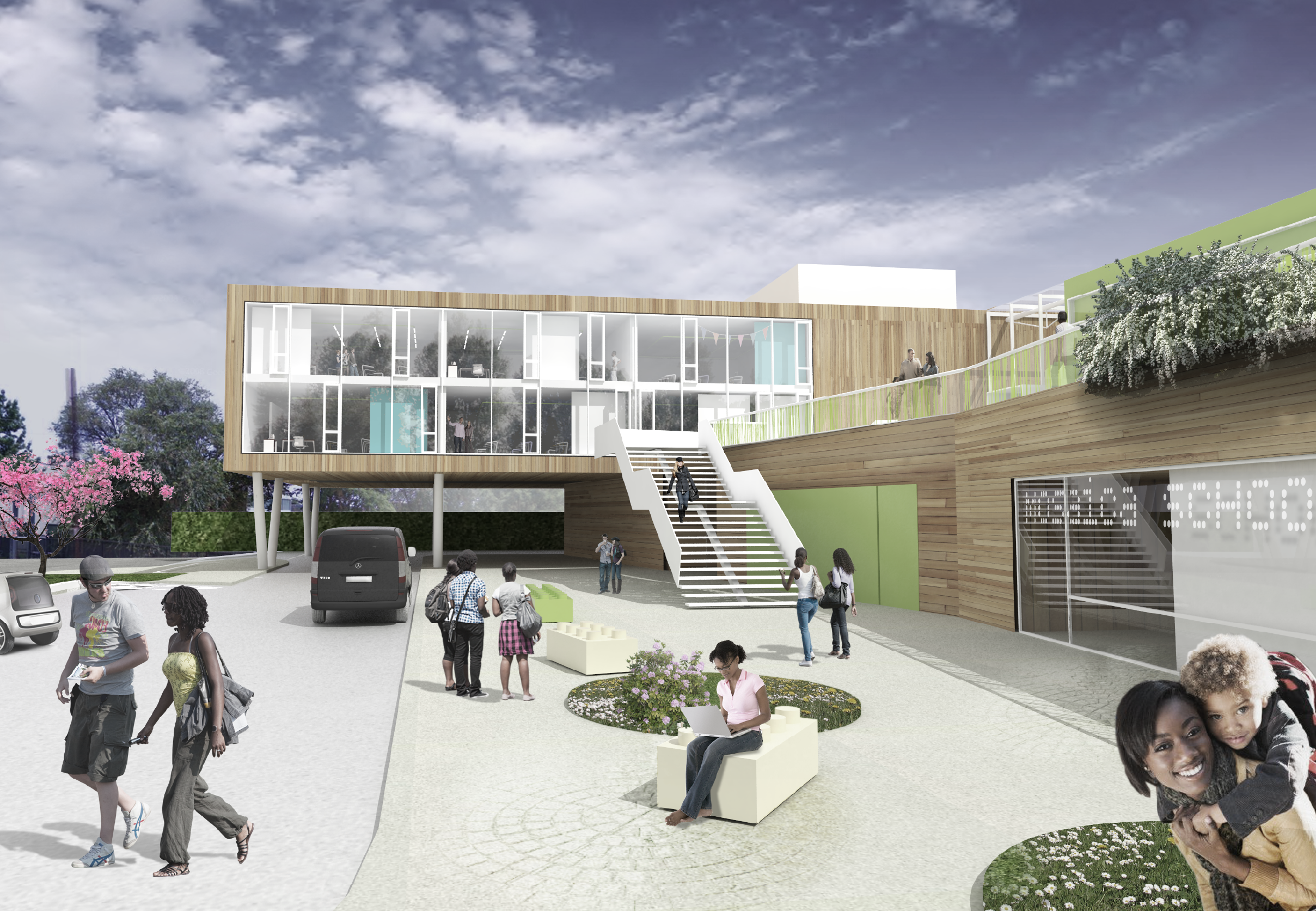
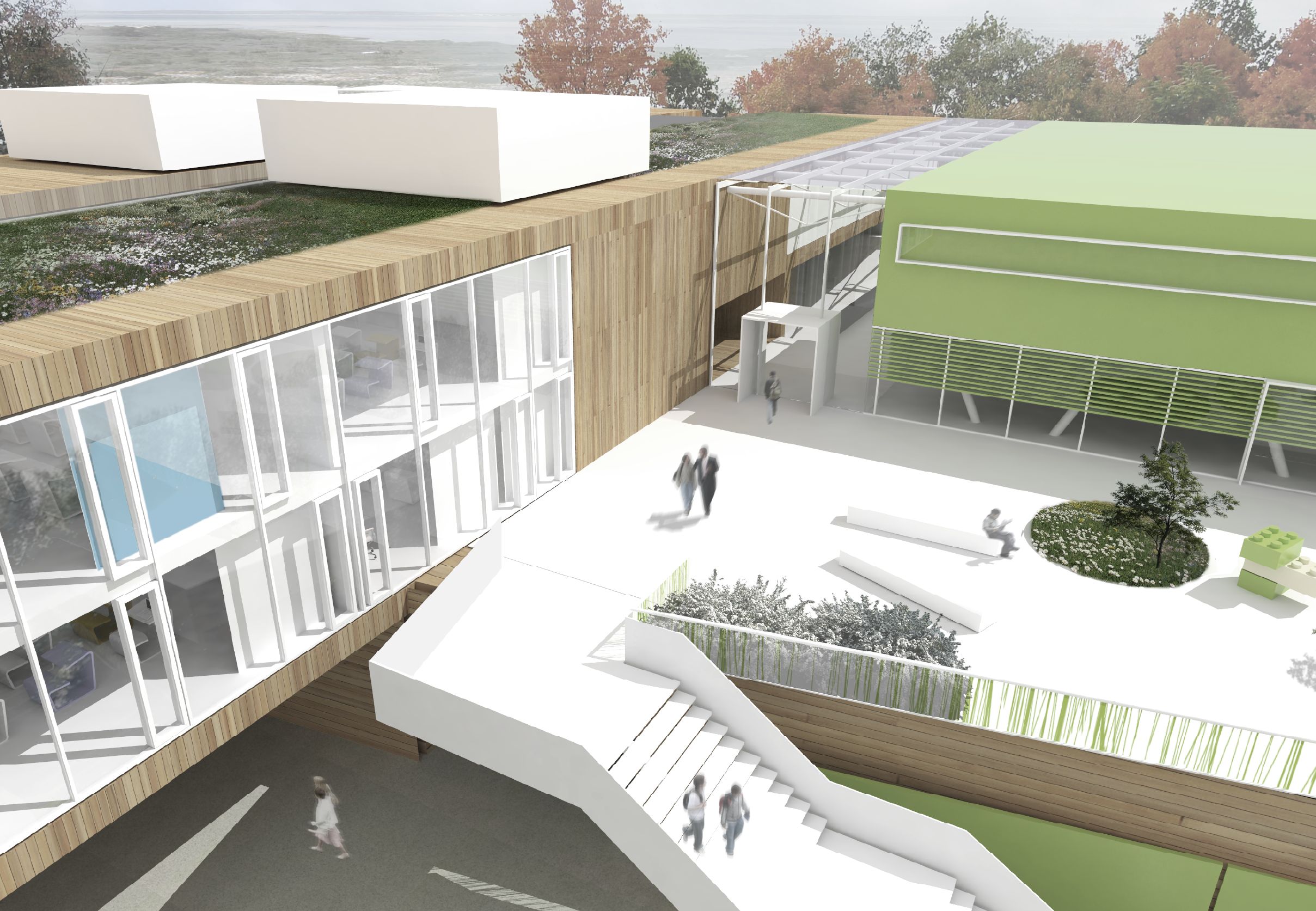
The design of the school is based on the Paragon Teaching Method employed by the school, which replaces the traditional history and social studies curriculum. The building is designed to exemplify the Mosaica teaching model and physically represent the program inspired within each space. The building is divided into Play + Performance, Visual Arts, and Interdisciplinary Studies. Given the constrained site, the Interdisciplinary Studies wing, raised to afford parking, is clad with a polychrome of colored panels, the Play + Performance wedges below to support and stimulate with a panel striation based on musical scores, and the Arts wing folds to create entry and connection gallery between an adjacent existing school building.
2 Schools, 1 Campus
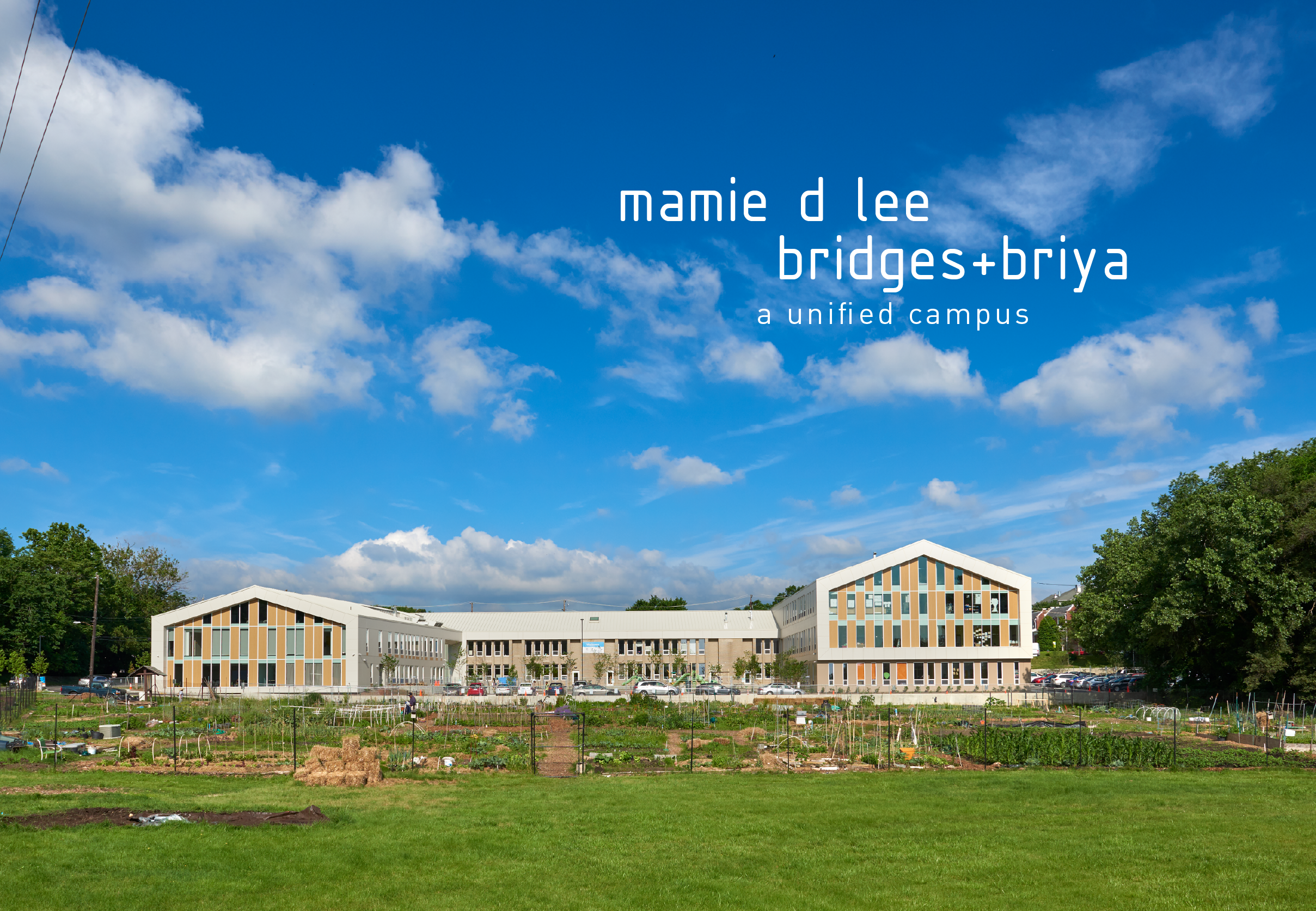
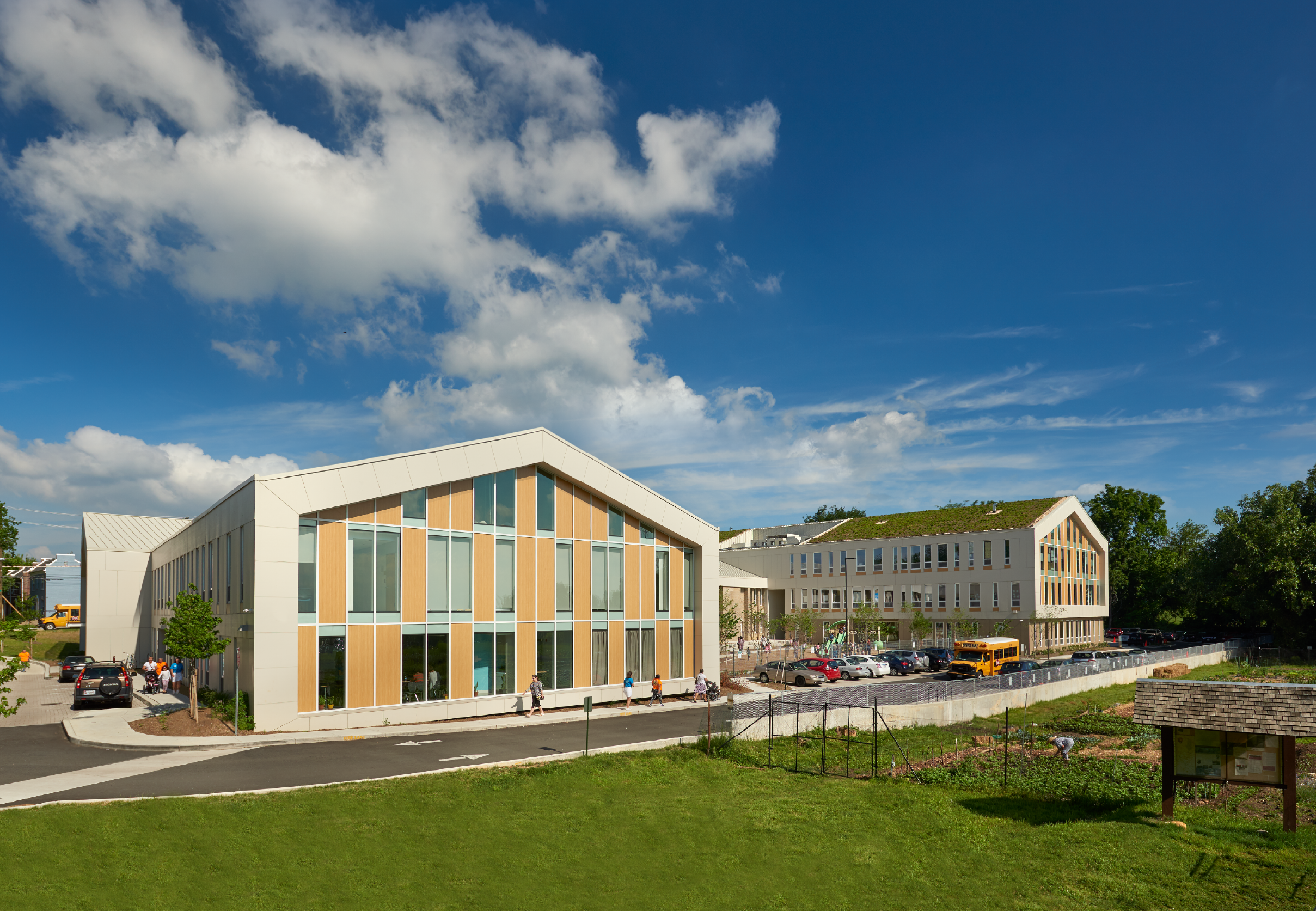
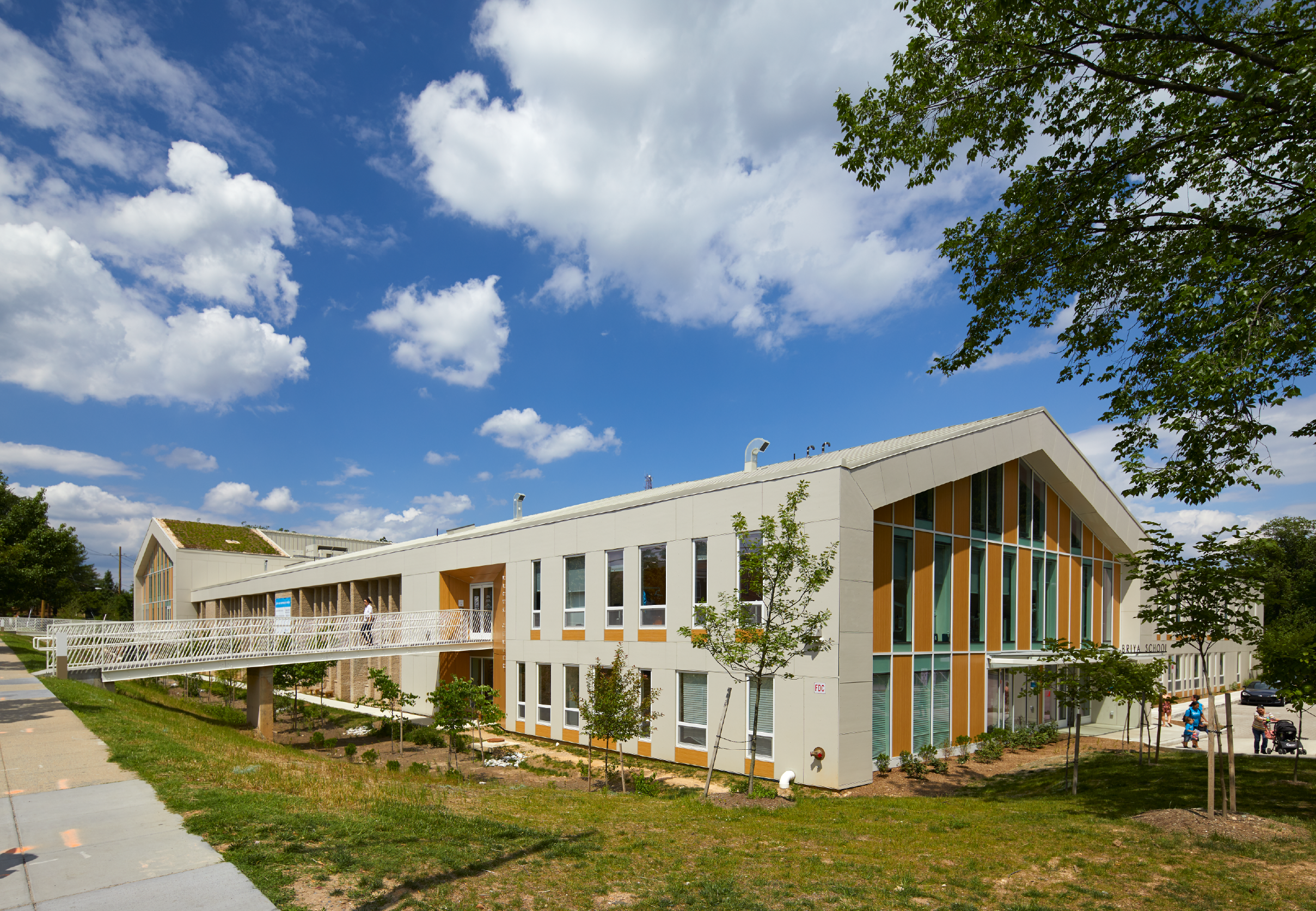
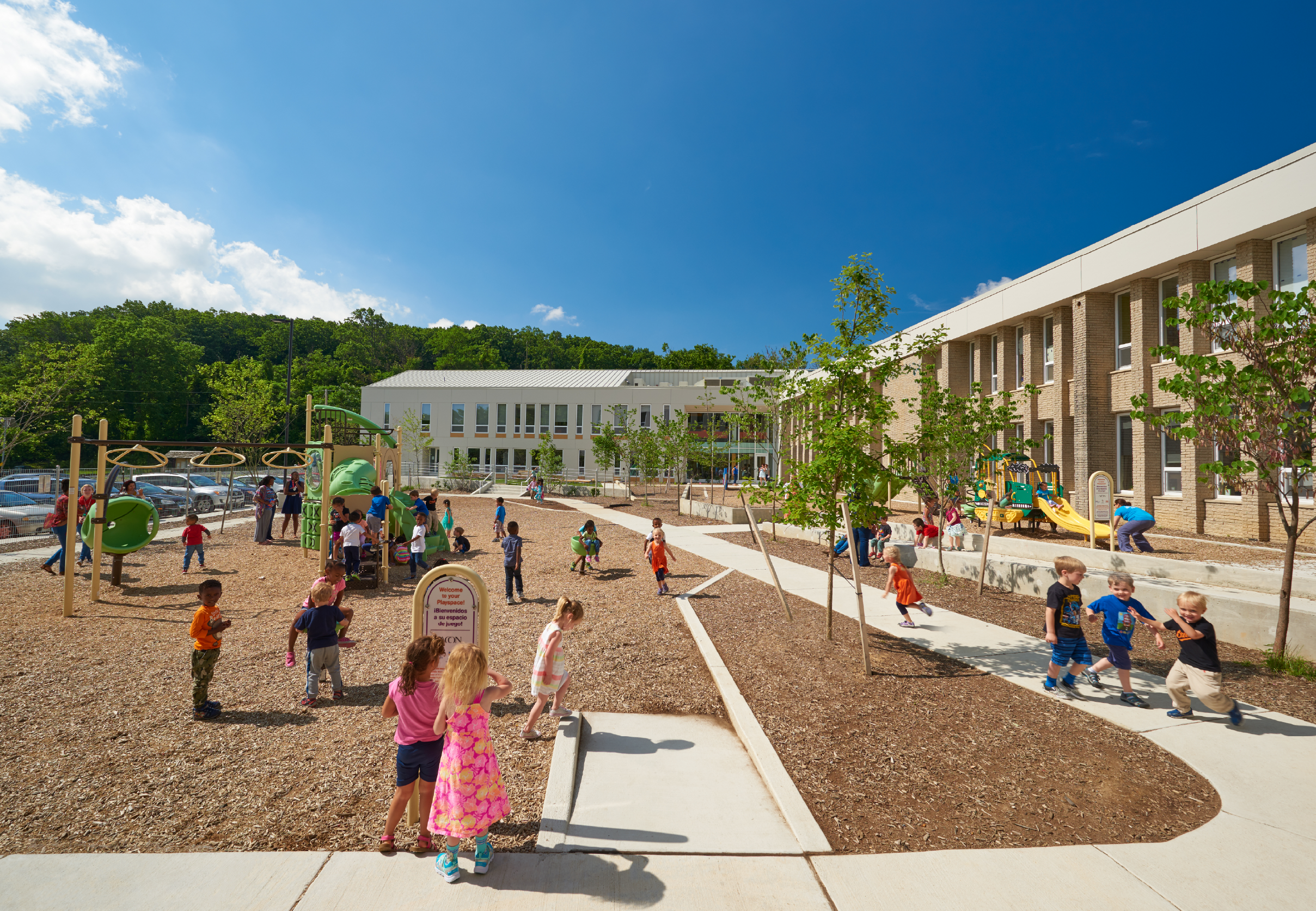
The Bridges + Briya campus is an oasis of community, learning, and play nestled into Fort Totten Park. Located in a dense neighborhood at the intersection of major public transit lines, bike routes, and pedestrian paths, the site is easily accessible to the neighborhood and the region. The building is home to three entities: Bridges Public Charter School, Briya Public Charter School, and Mary’s Center Community Health Center. Each program uniquely serves a diverse community of families; building understanding, awareness, and support among themselves, the staff, and the surrounding neighborhood.
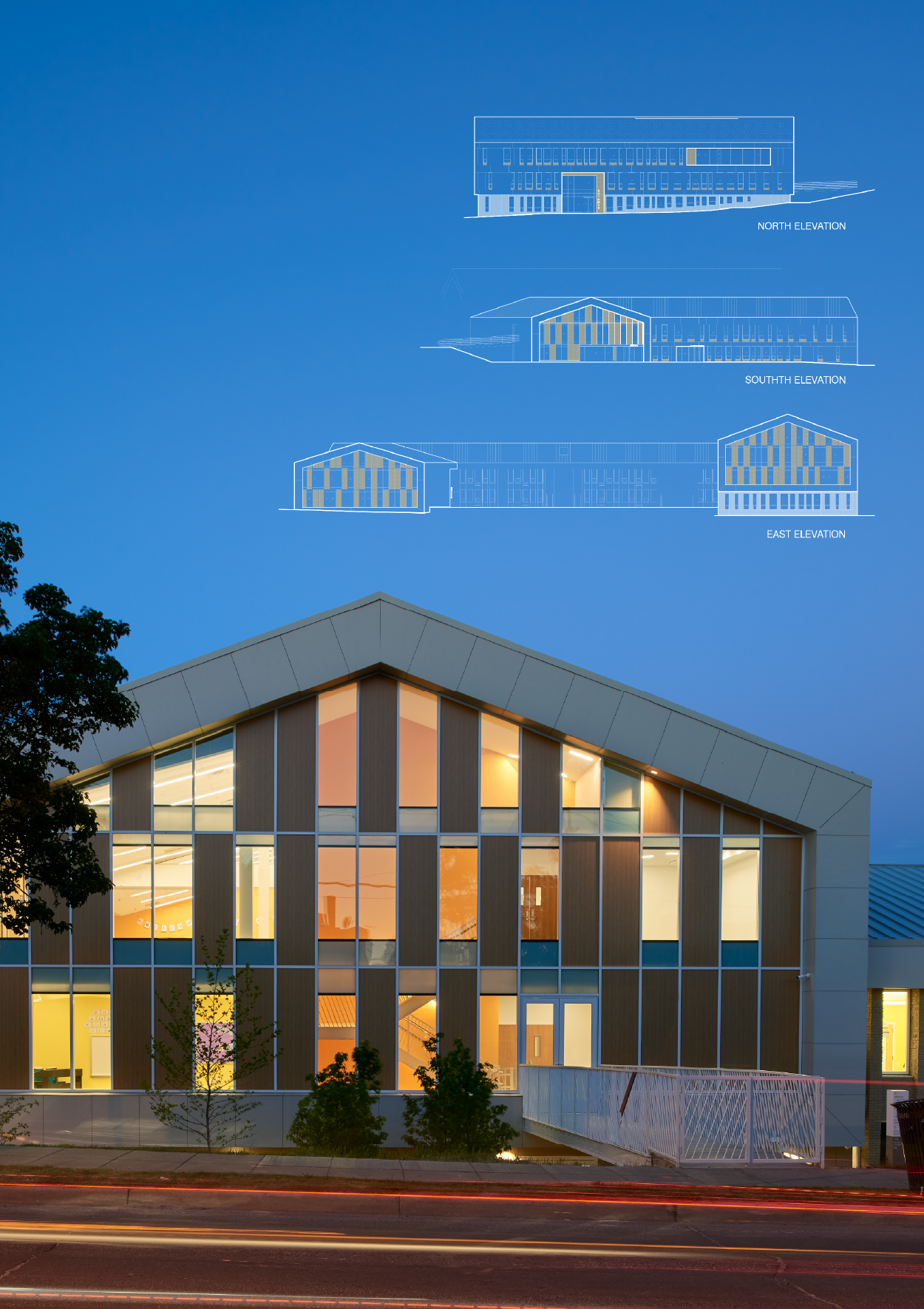
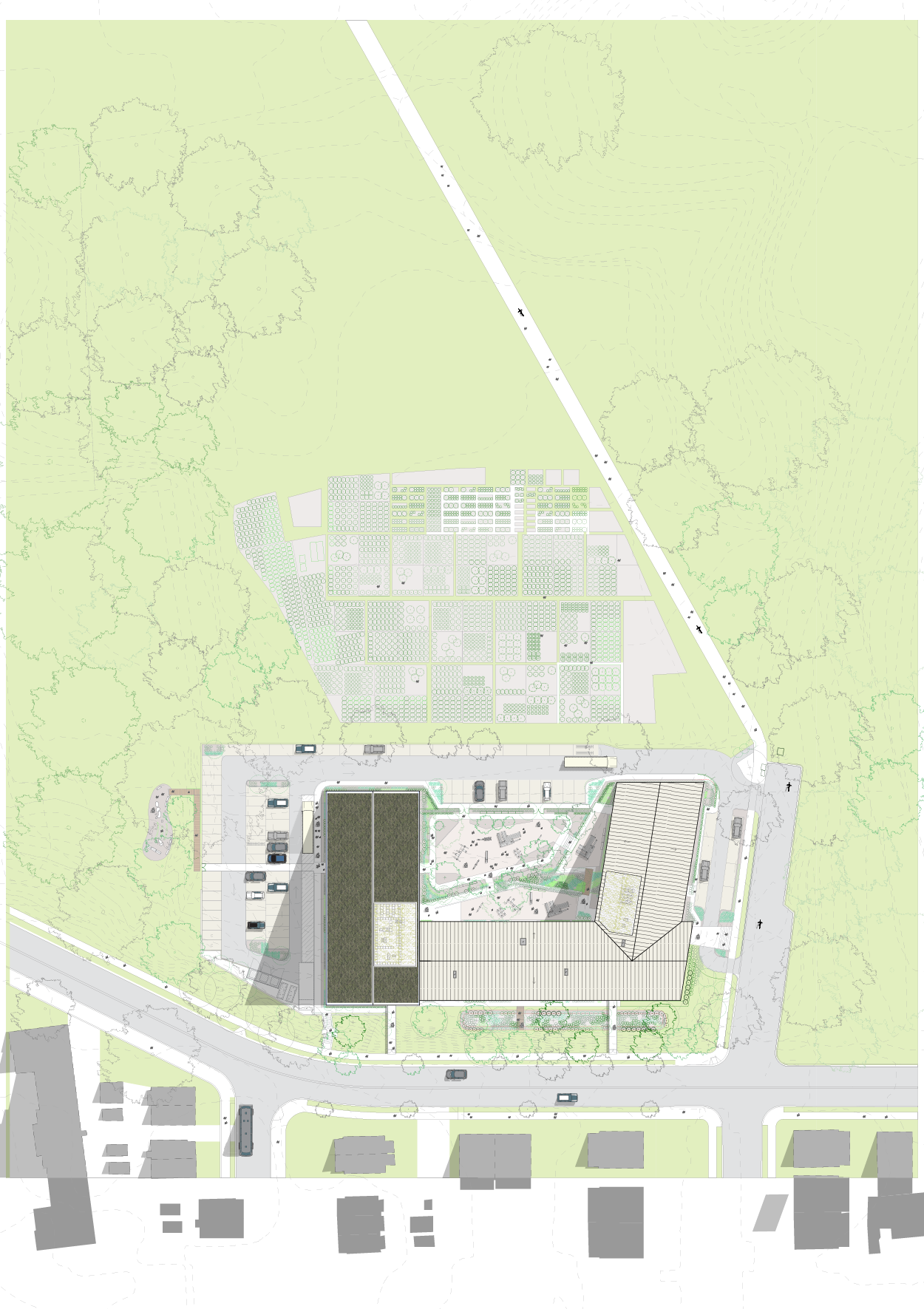
The original school is a cluster of three one-story and one two-story structures grouped around a central stepped, concrete courtyard. The proposed design was to demolish the three one-story structures and renovate the one two-story structure. New additions were then provided at both ends of the renovated structure. This resulted in a “u-shaped” building that created a central courtyard open to the large green space maintained by the National Park Service next door. One addition is two stories, the other addition is three stories, and they both have peaked roofs to match the original structure. Fenestration patterns for the new additions take cues from the original school. The original school has brick facades on a concrete plank structure while the new additions are either a concrete or metal panel screen wall assemblies on steel frames.

Community Connections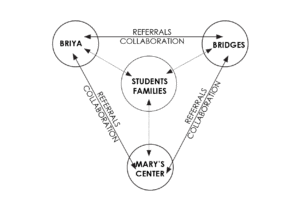
The Mamie D. Lee School was built by the District of Columbia in 1967 for “special-needs” children. After a procurement process in 2014, the city awarded the building to a team comprised of three different members. Those members are Bridges Public Charter School, Briya Public Charter School, and Mary’s Center. Bridges Public Charter School specializes in providing all-inclusive learning programs and environments for “special-needs” children. Briya Public Charter School is a school that specializes in adult education along with infant and toddler care. Mary’s Center is a federally qualified health center that provides health care, family literacy, and social services to individuals whose needs too often go unmet by the private systems. Bridges occupies 35,000 square feet of the new facility, Briya occupies 23,000 square feet, and Mary’s Center leases 12,000 square feet of the 80,000 square foot building.
Green Connections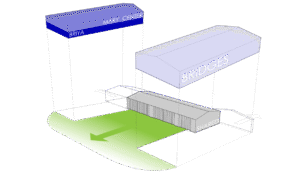
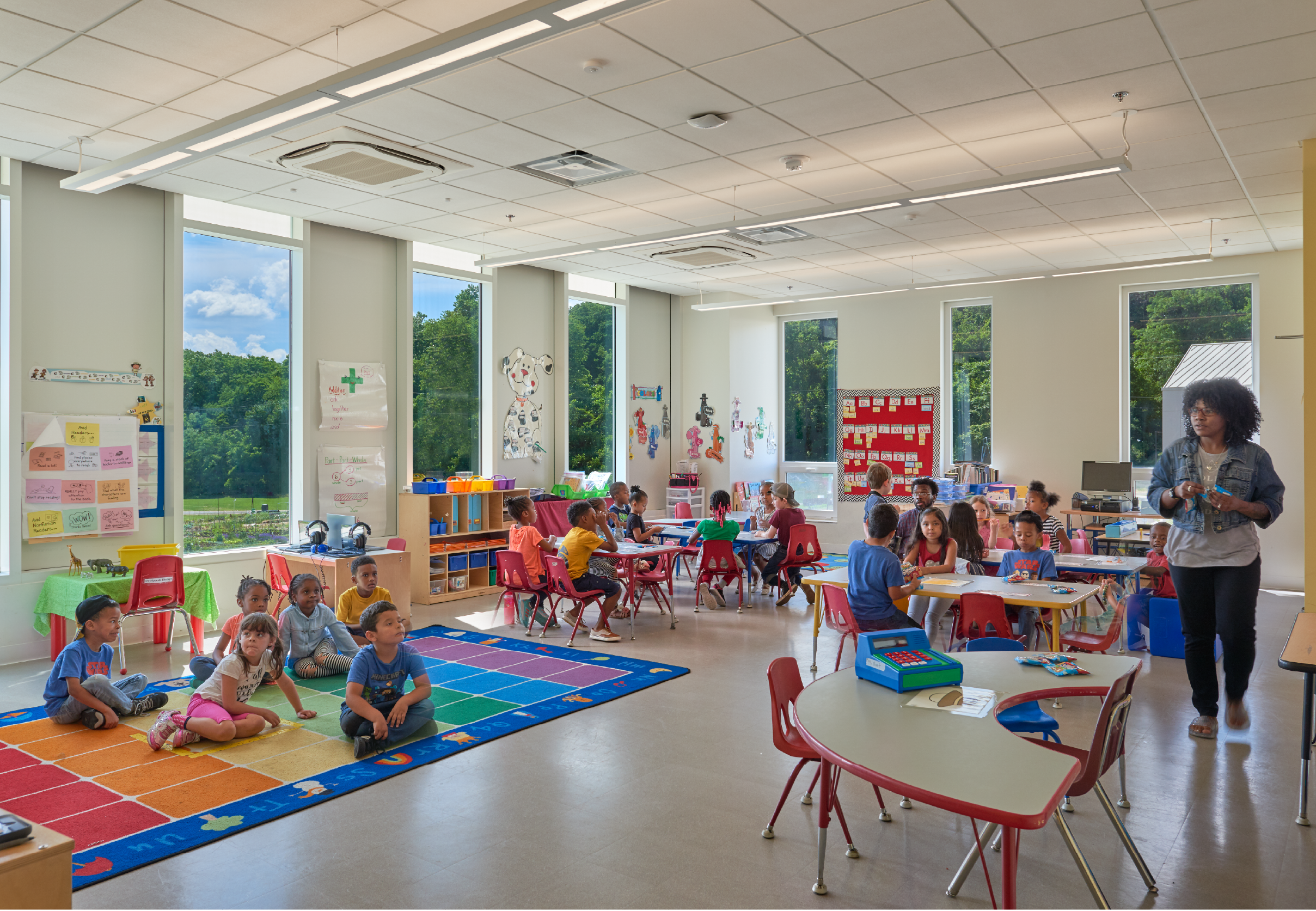
The landscaping of the Bridges + Briya campus was vital in connecting its inhabitants to its natural surroundings and achieving its sustainability goals. The “u-shaped” plan opens towards the expansive community garden of Fort Totten Park, extending the “greenscape” into the courtyard shared by the two schools. Maximizing the perimeter of the building allowed all classrooms and core learning spaces to achieve 100% daylighting and views through a playful arrangement of windows oriented towards the beautiful Fort Totten Park and the courtyard. In addition to the fully indigenous landscaping, 17,000 square feet of permeable pavers, 2,000 square feet of bio-retention, and 10,000 square feet of sloping green roof are used to balance the storm water management.
Strategic Programming
At an early point in the project, a team comprised of Bridges and Briya school leadership, financier, project manager, architect, and general contractor participated in the Learning Environments For Tomorrow (LEFT) Institute. LEFT is a four-day, invitation-only event for K-12 school construction project teams sponsored by the Harvard University Graduate School of Education and Graduate School of Design. The goal of LEFT is to explore the challenges of designing spaces that enable personalized learning for students, support social and emotional development for both adults and children, better engage families and communities with schools, and include new media and information technology. At LEFT, the B+B team was divided and recombined with other attendees into LEFT project teams, and those new teams each developed a case study school construction project through the conceptual floor plan stage.
The case study process at LEFT is organized around the “Five Ps”: People, Programs, Principles, Particulars, and Plans. Simultaneously, the B+B team also met to discuss the Mamie D. Lee campus framed in the terms of this Five Ps language. The Five Ps offer a deeper understanding of architectural program. They unpack assumptions and identify issues that are not visible in the most basic form of architectural program, which is a list of spaces and an adjacency diagram.
people >>> program >>> principles >>> particulars >>> plans
In the case of the B+B team, the result of the Five Ps includes symbolic diagrams of the relationships between the three institutions and the ways they can collaboratively serve a single family. The team generated maps of the site vicinity to reveal sensitivities to the different ways various institutions’ staff, students, and clients arrive to the site as well as opportunities to engage neighboring institutions and nearby public facilities. Narrative diagrams capture the experience of a typical student through a typical day.
These plans became the common generative spring-point from which the conceptual design for the project began. The LEFT activities establish a shared vision for the project through gathering the common aspirations of all team members to realize a better future for the children and community.
Project Teams:
Two Rivers:
Client: Two Rivers Public Charter School
Contractor: MCN Build
Consulting Team:
Construction Manager: Building Hope
Structural Engineer: Ehlert Bryan
Civil Engineer: Christopher Consultants
MEP Engineer: Engenium Group
IT Consultant: Educational Systems Planning
Acoustic Consultant: Acoustical Design Collaborative, Ltd.
Photography: Copyrighted Hoachlander Davis Photography
Achievement Preparatory Academy:
Client: Achievement Preparatory Academy
Contractor: MCN Build
Consulting Team:
Construction Manager: Brailsford & Dunlavey
Structural Engineer: Ehlert Bryan
Civil Engineer: Christopher Consultants
MEP Engineer: Setty Associates International
Landscape Architect: Siteworks Studio
Telecomm/AV/Security: GenesysImpact
Financing by Building Hope
Photography: Copyrighted Hoachlander Davis Photography
KIPP DC Legacy College Preparatory:
Client: KIPP DC
Contractor: MCN Build
Consulting Team:
Construction Manager: Jair Lynch
Structural Engineer: Ehlert Bryan
Civil Engineer: Christopher Consultants
Geotechnical Engineer: ECS Capitol Services
MEP Engineer: CMTA
Landscape Architect: Kennon Williams Landscape Studio
Food Service Consultant: Nyikos Garcia Foodservice Design
Acoustic/Technology Consultant: Polysonics
Transportation Engineer: Gorove/Slade
Dry Utility Consultant: DFM Development Services
Security Consultant: Arup
Photography: Copyrighted Hoachlander Davis Photography
Washington Liberty High School Annex:
Client: Arlington Public Schools
Contractor: MCN Build
Consulting Team:
Structural Engineer: Ehlert Bryan
Civil Engineer: Christopher Consultants
MEP Engineer: CMTA
Materials Science: Wiss, Janney, Elster Associates
Acoustic Consultant: Acoustical Design Collaborative
Transportation Engineer: Gorove Slade
Photography: Copyrighted Hoachlander Davis Photography
Mosaica Academy Howard Road Campus: Unbuilt
Mamie D. Lee, Bridges + Briya
Client: Bridges Public Charter School and Briya Public Charter School
Contractor: MCN Build
Consulting Team:
Construction Manager: Brailsford & Dunlavey
Structural Engineer: Silman
Civil Engineer: Christopher Consultants
MEP Engineer: Setty & Associates
Landscape Architect: Jordan Phemister
IT and Access Control Engineer: Genesys Impact
Financing by Building Hope
Photography: Copyrighted Hoachlander Davis Photography
STUDIOTWENTYSEVENARCHITECTURE is:
John K. Burke, AIA, Principal In Charge
Jacob Marzolf, AIA, Associate Principal
Bethan Llewellyn-Yen, RA, LEED AP BD+C
Niki Livingston
Claire Barrows, AIA
Keisha Wilson, LEED BD+C
Allyson Klinner, AIA
Lixu Wang, LEED Green Associate
Adrian Vera
Colleen Burke
Audrey Bolesta, LEED Green Associate
Moones Mirbeygi
Studio Twenty Seven Architecture is a collaborative design and research practice based in Washington, D.C. For more information and to stay up to date with Studio Twenty Seven, please visit our website at
www.studio27arch.com
First published 2024 by STUDIOTWENTYSEVENARCHITECTURE
www.studio27arch.com
COPYRIGHT:
© 2024 STUDIOTWENTYSEVENARCHITECTURE.
All rights reserved.
805 15th Street NW, Suite 430, Washington, DC 20005
All material is compiled from sources believed to be reliable, but published without responsibility for errors or omissions. We apologize for any omissions and, if noted, will amend in future editions.
No part of this document may be reproduced, stored in a retrieval system, or transmitted in any form or by any means, including electronic, mechanical, photocopying or microfilming, recording or otherwise, without permission from STUDIOTWENTYSEVENARCHITECTURE
Next Case Study
Fragment 11: An Architect's Travels Iceland
The Importance of Travel to an Architect A Brief History of Iceland and the Agenda Day Trips, Afterword....…
Read More

